28 July 2006

Loss versus Conditional Probability

There was a talk in the session I chaired at ACL about directly optimizing CRFs to produce low F-scores for problems like NE tagging and chunking. The technique is fairly clever and is based on the observation that you can use very similar dynamic programming techniques to do max F-score as to do max log-probability in CRFs.

The details are not particularly important, but during the question phase, Chris Manning asked the following question: Given that F-score is not really motivated (i.e., is a type 4 loss), should we really be trying to optimize it? Conditional probability seems like a completely reasonable thing to want to maximize, given that we don't know how the tags will be used down the pipeline. (It seems Chris is also somewhat biased by a paper he subsequently had at EMNLP talking about sampling in pipelines.)

I think Chris' point is well taken. Absent any other information, conditional probably seems like a quite plausible thing to want to optimize, since given the true conditional probabilities, we can plug in any loss function at test time and do minimum Bayes risk (in theory, at least).

On the other hand, there is an interesting subtlety here. Conditional probability of what? The standard CRF optimization tries to maximize conditional probability of the entire sequence. The "alternative objective" of Kakade, Teh and Roweis optimizes the sub of the conditional probabilities of each label. These are two quite different criterea, and which one should we choose? In fact, neither really seems appropriate. Conditional probability of the sequence doesn't make sense because it would rather improve a bad label from probability 0.01 to 0.1 than improve a bad label from 0.4 to 0.6 and thus get it right. But summed conditional probability of labels doesn't make sense in NE tagging tasks because always assigning probability 0.9 to "not an entity" will do quite well. This is essentially the "accuracy versus f-score" problem, where, when few elements are actually "on," accuracy is a pretty terrible metric.

If we take Chris' advice and desire a conditional probability, it seems what we really want is direct conditional probability over the chunks! But how do we formulate this and how do we optimize it? My impression is that a direct modification of the paper Chris was asking about would actually enable us to do exactly that. So, while the authors of this paper were focusing on optimizing F-score, I think they've also given us a way to optimize conditional chunk probabilities (actually this should be easier than F-score because there are fewer forward/backward dependencies), similar to what Kakade et al. did for conditional label probabilities.

25 July 2006

Preprocessing vs. Model

Back from Sydney now, and despite being a bit jetlagged, I thought I'd begin with an COLING/ACL-related post. There was a paper presented by Ben Wellington that discusses whether current syntax-driven models for translation can capture the sorts of reorderings/alignments observed in hand-aligned data. I'm not looking at the paper, but what I remember from the talk is that something like 5-10% of sentences are missed assuming an ITG-like model, without gapping.

At the end of the talk, Dekai Wu commented that they are aware of this for ITG and that an analysis of where it happens is essentially is "weird" extrapositions that occur in English, such as wh-movement, topical preposing, adverbial movements, etc. Apparently such things occur in roughly 5-10% of sentences (from whatever corpora were being used). This talk was near the end of the conference, so my buffer was near full, but my recollection is that the suggestion (implied or explicit) was that English could (should?) be "repaired" by unextraposing such examples, at which time a model like ITG could be directly applied to nearly all the data.

To me this seems like a strange suggestion. ITG is a very simple, very easy to understand model of translation; more natural, in many regards, than, say, the IBM models. (Okay, maybe in all regards.) One nice thing about the model is that it is largely un-hackish. Given this, the last thing I'd really want to do is to fix English by applying some preprocessing step to it, so that the output could then be fed into this nice pretty model.

There's an obvious generalization to this question, hinted at in the title of this post. It seems that in many problems (translation with ITG being but one example), we can either choose a theoretically clean but maybe not completely appropriate model plus some preprocessing, or a somewhat messier but maybe 99.9% recall model with no preprocessing. I suppose one could argue that this is the long sought after integration of rule-based and statistically-based NLP, but this seems uncompelling, because it's not really an integration. I suppose that I'd almost always prefer the latter sort of solution, but that's not to say the first isn't also useful. For instance, in the ITG case, after identifying cases where the ITG assumption fails, we could try to minimally enhance the ITG model to be able to capture these corner cases.

15 July 2006

Where are Interesting Learning Problems in NLP?

I just spent a few days visiting Yee Whye and NUS (photos to prove it!). YW and I talked about many things, but one that stood out as a ripper is attempting to answer the question: as a machine learning person (i.e., YW), what problems are there in NLP that are likely to be amenable to interesting machine learning techniques (i.e., Bayesian methods, or non-parametric methods, etc.). This was a question we tried to answer at the workshop last year, but I don't think we reached a conclusion.

At first, we talked about some potential areas, mostly focusing around problems for which one really needs to perform some sort of inference at a global scale, rather than just locally.  I think that this answer is something of a pearler, but not the one I want to dwell on.

Another potential partial answer arose, which I think bears consideration: it will not be on any problem that is popular right now.  Why?  Well, what we as NLPers usually do these days is use simple (often hueristic) techniques to solve problems.  And we're doing a sick job at it, for the well studied tasks (translation, factoid QA, ad hoc search, parsing, tagging, etc.).  The hunch is that one of the reasons such problems are so popular these days is because such techniques work so bloody well.  Given this, you'd have to be a flamin' galah to try to apply something really fancy to solve one of these tasks.

This answer isn't incompatible with the original answer (globalness).  After all, most current techniques only use local information.  There is a push toward "joint inference" problems and reducing our use of pipelining, but this tends to be at a fairly weak level.

This is not to say that Bayesian techniques (or, fancy machine learning more generally) is not applicable to problems with only local information, but there seems to be little need to move toward integrating in large amounts of global uncertainty.  Of course, you may disagree and if you do, no wuckers.

p.s., I'm in Australia for ACL, so I'm trying to practice my Aussie English.

13 July 2006

Conference Formats

There are two conference formats I'm familiar with. One is typified by ACL and ICML; the other by NIPS. The ACL format is a roughly 3 day schedule, with three parallel sessions, which gives time for somewhere around 80 presentations, each 20 mins + 5 for questions. ACL has smallish poster sessions that are typically associated with "short papers." My impression is that many people do not attend the poster sessions.

In contrast, NIPS typically accepts many more papers (120ish per year), but the vast majority are presented as posters. There is only one track at the conference, with several invited talks, a few paper presentations (maybe 15 total) that last 20 minutes. They also have "spotlight presentations", which are 2 slide, 2 minute talks designed to draw attention to particularly interesting posters. The poster sessions run from (roughly) 6 until 10 every night and are attended by everyone.

My feeling is that both formats have advantages and disadvantages.  I personally like the NIPS format, essentially because I feel that at the end of the conference, I have seen more of what is there (because I spend so much time at posters).  This also means that I'm completely exhausted at the end of NIPS.  The major disadvantage to the NIPS format seems to be that I'm used to using post-conference time as dinner socialization time, and this seems to happen somewhat less at NIPS (this is confirmed by a friend who is more in the "in crowd" at NIPS than I am).  I think that it might be a little intimidating for junior researchers to go up to a "famous" poster, but on the other hand, this forces you to immediately get to know everyone.  The "lots of posters" format also means that the decision about the number of papers to accept at NIPS is essentially limited by physical space, rather than length of the conference.  Ken Church seems to think we should be accepting more papers, anyway.

Are there other major disadvantages to having a single-track conference, with the majority of papers presented as posters?  I don't expect to see a shift in how our conferences are held, but I'd like to understand all the pros and cons.

Visa Problems entering USA?

Some people are trying to do something about it (contacting congressmen, etc.). If you've had problems entering the US for conferences, you should contact them.

07 July 2006

What is Natural Language Understanding?

I've read lots of papers and seen lots of talks that justify a task as being useful to doing "natural language understanding." The problem I have here is that I really have no idea what NLU actually is. I think the standard line is that NLU is the process of transforming natural language text into "some representation" that is "easy" for a computer to "manipulate." Of course, the quoted words are so vacuous in meaning that I can easily imagine reasonable definitions for them that make this task either trivial or essentially impossible.

What I find unfortunate here is that, without trying hard to pin down definitions, this seems like a completely reasonable goal for NLP technology; in fact, my impression is that up until 10 or 20 years ago, this actually was one of the major goals of the field. According to the anthology, roughly 25% of the papers in 1979 contained the terms "NLU" or "language understanding", compared to 20% in the 1980s, 10% in the 90s and 7% in the 2000s. One possible explanation of the dwindling of this topic is that publication has become increasingly driven by experimental results, and if one cannot pin down a definition of a task, one cannot reliable compare results across multiple papers.

The recent push on textual entailment bears some semblance to NLU, but is simultaneously better defined and more restricted (though I admit to having heard some grumbling that some more work needs to be done to get textual entailment to be a very well defined task). There also continues to be a modicum of work on database filling and natural langauge database queries, though certainly not at the same rate as before.

03 July 2006

My Thesis Path

(Minor note: the latest version of the EDT section didn't get folded in properly to the version of the thesis that went up yesterday; this is fixed now.)

Many people have asked me how I settled on a thesis topic, I think largely because they are trying to find their own paths. My story is (at least to me) a bit odd and circuitous, but I'll tell it anyway.

When I came to USC, I knew I wanted to do NLP and, more specifically, I wanted to do summarization. Working with Daniel was a natural choice. I was particularly interested in coming up with good models for getting around the sentence extraction paradigm that dominates the field. My first work was on extending Kevin and Daniel's sentence compression work to the document level by using discourse information. This worked reasonably well. My next milestone was to try to leverage alignment information of document/abstract pairs in order to learn complex transformations. This led to the segment HMM model for doc/abs alignment, that met with reasonable success (considering how darned hard this problem is).

At that point, it became clear that trying to do a full abstractive system just wasn't going to work. So I started looking at interesting subproblems, for instance sentence fusion. Unfortunately, humans cannot reliably do this task, so I threw that out, along with a few other ideas. Around the same time, I began noticing that to have any sort of reasonably interesting model that did more than sentence extraction, I really was going to need to run a coreference resolution system. So I went to the web (this was back in 2003) and found one to download.

Except I didn't because there weren't any publicly available.

So I went to build my own. I wanted to do is "right" in the sense that I wanted a principled, joint system that could be trained and run efficiently. I read a lot of literature and didn't find anything. So then I read a lot of machine learning literature (I was beginning to get into ML fairly hardcore at this point) to find a framework that I could apply. I couldn't find anything.

So I decided to build my own thing and came up with LaSO, which is essentially a formalization and tweak on Mike Collins and Brian Roark's incremental perceptron. My thesis proposal used LaSO to solve the EDT problem, and I presented LaSO at ICML 2005. Also at ICML 2005 I met John Langford, having previously noticed that what I was doing with LaSO looked something like some recent work he had done on reinforcement learning. We had a long dinner and conversation and, after a few visits to Chicago, many emails, and lots of phone calls, came up with Searn. With both LaSO and Searn, I always had in the back of my mind that I didn't want to make any assumptions that would render it inapplicable to MT, since everyone else at ISI only does MT :).

At about the same time, I started thinking about how to do a better job of sentence compression and came up with the vine-growth model that eventually made it into my thesis. This was really the first point that I started thinking about summarization again, and, in the evolution of LaSO to Searn, it now became possible to do learning in this model.

So, in a sense, I had come full circle. I started with summarization, lost hope and interest, began to get more interested in EDT and machine learning, and then finally returned to summarization, this time with a new hammer.

02 July 2006

Thesis is Done!

I'm happy to announce that my thesis, Practical Structured Learning Techniques for Natural Language Processing, is now done (which is good, because it needs to be handed in by 11:59pm on July 5th). Many thanks to everyone who supported me through this (long) process; I really appreciate it.

27 June 2006

Beating an N-Gram

Our entry into the NIST MT eval this year has a recapitalization component, currently being done by a large language model (500mb, gzipped) together with SRILM's "disambig" tool. I was recently conscripted to try to improve this. After about a week's worth of work, using a bunch of tools and rules and a bunch of other stuff (though not 100% tuned), I've eeked out a 0.25 increase in BLEU scores on the 2003 and 2004 test data for three of our MT systems (phrase-based, syntax-based and Hiero). This could easily be upped to maybe 0.5 with a few more hours of work (there are tokenization differences between my training and test data).

The story that it's hard to beat an n-gram language model is fairly ubiquitous. In fact, my most useful features for classification are based on the n-best outputs of disambig using the large LM. There are older results that suggest that once you have enough data, using stupid techniques is sufficient. This seems to be more true for NLP than for many other areas I know about, though perhaps this is because there exist NLP problems for which it is even possible to get a "sufficient" amount of data.

While this story is true for English, I'm not sure that it would hold for other languages. My guess is that n-gram models work significantly worse in languages with more free word order and (though this usually comes as a package deal) stronger morpology. As a counter-argument, though, some of my friends who have contact with people who do commercial speech recognition in languages other than English do actually use vanilla n-gram models in those other languages. I don't know whether this is for lack of an alternative or just because they remain so good even outside of English.

I don't know the secret sauce to beating an n-gram. They appear to work so well because language (where, by "language" I mean "English") is really not that ambiguous, in a Shannon-experiment sense. Moreover, raw English words seem to really be just about right when it comes to information content. Sure, we can get some mileage by looking at suffixes or bigrams, but, comparing to, say, German (where one word can correspond to 2-3 English words), English really seems to strike the right balance of amount of information in a word to sparsity (where "right" = "right for NLP"). I'm sure other languages fall fairly close by and I recall seeing a study comparing Shannon-style tests in multiple languages (anyone know a pointer?), but, if pressed, this is my guess as to why n-grams work so well. To beat them, it seems we are almost forced to look at problems with less data, or problems which are significantly noisier.

19 June 2006

Having an Impact

Having just completed my thesis, I've been thinking a lot about what directions I should persue, post-graduation. While I'll probably stick with some of the stuff I've been working on in the past, this is also an opportunity to diversify. This opens the question: what are promising areas to work on? One important qualification (though by no means the only one) is impact: I want to work on things that are important, either in the sense that they become tools used by others for a diverse set of problems, or change the way people think about or look at a particular area.

Rather than applying my own model for what work has been important, one can look back at what other people think have been the most influential papers in NLP, as well as what papers have won best paper awards recently (with the caveat that the latter is probably less indicative). The story seems to be that the most impactful papers, at least as measured by this criteria, are either MT papers, parsing papers or machine learning papers. This makes some historical sense: MT is sort of the quintessential NLP application, while parsing is essentially the language-for-language's sake task.

This analysis, unfortunately, puts me in a sticky situation. I've already been doing machine learning stuff, which I hope will turn out to be useful for other people. I'd ideally like to get back into really languagey stuff in the future, and this leaves parsing at MT. I have little interest in working on parsing (nothing against parsing: it's just not my thing, and there are lots of people who can probably do it better than me), so now I'm stuct with MT. MT is, without a doubt, an interesting topic. But the field is so crowded right now, it seems difficult to find a sufficiently large and interesting niche to carve out. I personally think out-of-English translation is promising, especially conjoined with morphological research (pretty much required when going into a highly inflected language), but there are a large number of barriers to entry to this problem (evaluation, my American-esque inability to speak any foreign language sufficiently reliably to do error analysis (except Japanese, but there's so little data there), etc.).

But regardless of my personal interests and limitations, the fact that the field is so dominated by two problems seems unfortunate. There are 44 bins that ACL allowed you to select for your topic this year and while many of them largely overlap, there are many that do not. Why, for instance, does research in discourse, inference, phonology, question answering, semantics, and word sense disambiguation have comparatively little weight in the field as a whole? Why are there six sessions on MT (plus one multilingual), six on parsing (plus two on grammars), but only two on semantics and discourse and one on language modeling at ACL this year? And beyond that, there seem to be lots of interesting problems that no one is working on (or at least that no one publishes at ACL). I do not doubt that these are interesting problems, but it seems that there is a severe skew that may not be healthy to the community.

15 June 2006

Approximating the Problem or the Solution

A while back I came across a paper that (in a completely separate context) argues for approximating problems in lieu of approximating solutions. This idea has a nice analogue in NLP: should we (A) choose a simple model for which we can do exact inference or (B) choose a complex model that is closer to the truth for which exact inference is not tractable. (A) is approximating the problem while (B) is approximating the solution.

It seems that all signs point to (B). In almost every interesting case I know of, it helps (or at the very least doesn't hurt) to move to more complex models that are more expressive, even if this renders learning or search intractable. This story is well known in word alignment (eg, GIZA) and MT (eg, model 4 decoding), but also has simpler examples in parsing (cf, McDonald), sequence labeling (cf, Sutton), relation extraction (cf, Culotta), as well as pretty much any area in which "joint inference" has been shown to be helpful.

One sobering example here is the story in word alignment, where one cannot go and directly use, say, model 4 for computing alignments, but must first follow a strict recipe: run a few iterations of model 1, followed by a few model 2, followed by some HMM, then model 4 (skipping model 3 all together).  The problem here is that learning model 4 parameters directly falls into local minima too easily, so one must initialize intelligently, by using outputs of previous iterations.  My guess is that this result will continue to hold for training (though perhaps not predicting) with more an more complex models.  This is unfortunate, and there may be ways of coming up with learning algorithms that automatically initialize themselves by some mechanism for simplifying their own structure (seems like a fun open question, somewhat related to recent work by Smith).

Aside from a strong suggestion as to how to design models and inference procedure (i.e., ignore tractability in favor of expressiveness), there may be something interesting to say here about human language processing.  If it is indeed true that, for the most part, we can computationally move to more complex models, forgoing tractable search, then it is not implausible to imagine that perhaps humans do the same thing.  My knowledge in this area is sparse, but my general understanding is that various models of human language processing are disfavored because they would be too computationally difficult.  But if, as in old-school AI, we believe that humans just have a really good innate search algorithm, then this observation might lead us to believe that we have, ourselves, very complex, intractable "models" in our heads.

13 June 2006

Incremental Improvements

I usually think of incremental improvements as the result of taking an existing result X and twiddling X a little to yield Y. This can happen in system development (adding syntax to my MT system helped), theory (Y is a straightforward corollary of X), etc. Incremental improvements are often uninteresting, unless your research area happens to be exactly that of X (i.e., if I work on MT, maybe I will try adding syntax now). But in a broader sense, everything is an incremental improvement. It is vanishingly unlikely that a paper will come along that is not incremental in some sense.

I think what often ends up making a paper more or less successful is how many incremental improvements it contains. For instance, the original CRF paper was clearly successful. Yet, mathematically, CRFs are only incrementally different from MEMMs. Experimentally, they only perform slightly better. Algorithmically, the optimization is only slightly more clever than inference in HMMs. Theoretically, they can solve only a slightly broader family of problems. But importantly, all of these advantages come in a bundle. The CRF is a success largely because a single, relatively simple formalism made (incremental) improvements in at least four areas. I think you can make similar arguments about other "must reads" in NLP, such as Collins' original parsing paper.

If true, this might lead one to make research and accept/reject decisions on the basis of the number of areas in which improvements are made. This would certainly cut down on the number of papers published, but I also feel that many purely incremental papers do end up being useful, if only as steps in a path. For instance, MEMMs themselves are much more incremental upon HMMs, maximum entropy models and some older work by both Brill and Roth. The important question is whether CRFs would have been discovered, had MEMMs not been used and exhibited problems (eg., the label-bias problem). Of course, such observations are easy in retrospect: I don't know how to identify them without seeing the goal.

(Incremental improvements also serve a second role: they are advertisements for the original technique, for those who missed it the first time around.)

09 June 2006

NAACL: The post-hoc short-list

NAACL is over, and while the majority of the conference took place in hallways for me this time around (lots of old and new friends made their way to NYC), I did get a chance to see a few papers that I enjoyed. I'm short-listing some of them here (including workshop papers), though I encourage others to list those that they liked, since one person can have at most a 33% recall.

  • Effective Self-Training for Parsing (McClosky, Charniak + Johnson). Train a parser A, run A on 2m sentences, use A's output to train a new parser B and B does better on test data. This is a somewhat surprising story, and one that has plenty of counterexamples in the literature. These guys got it to work. The key was to use the Charniak + Johnson reranking parser as parser A, rather than just the Charniak parser. This begs the question: why does it work in the latter case. Unfortunately, the paper doesn't answer this question. Though talking to Eugene, they are interested in ideas why.

    One obvious idea is that the epsilon difference in performance for reranking and not reranking happens to occur at a phase transition. I find this unlikely. My guess (which I've suggested and they seem interested in exploring) is the following. The unreranked parser produces systematic errors, and so self-training just reinforces these errors leading to worse performance. In contrast, the reranked parser has a high variance of errors (this is intuitively reasonable if you think about how reranking works) and therefore these come across as "noise" when you retrain on the large corpus. It's easy to verify this claim: simply remove enough data from the reranked parser so that its performance is comparable to the vanilla parser and see if you still get self-training improvements. If so, I may be right. One can then do a more exhaustive error analysis. Other people have suggested other reasons which I think the Brown folk will also look into. I'm very curious.

  • Prototype-driven Learning for Sequence Models (Haghighi + Klein). This received the best student paper award (congrats Aria!). The idea in this paper is that we don't want to have to label entire sequences to do normal supervised learning. Instead, what we do is, for each possible label, we list a small number of prototypical words from that label. They then use a constrained MRF, together with distributional similarity features to attempt to learn a sequence labeling model. I think this idea is very interesting, and I am in general very interested in ways of using "not quite right" data to learn to solve problems.

    My only concern with this approach is that it is quite strict to require that all occurances of prototypical words get their associated tag. This is perhaps okay for something like POS tagging, but in general problems, I feel that words are too ambiguous for this to work. (And, for completeness, since I asked this question at the talk, I would have liked to have seen at least one baseline model that made use of the prototypes, even in a naive way.)

  • Quasi-Synchronous Grammars: Alignment by Soft Projection of Syntactic Dependencies (D Smith + Eisner, SMT Workshop). This paper makes the argument that the raw synchronicity assumptions made by SCFGs for either projection or translation is too strong (others, like Hwa, have argued the same). They analyze the sorts of transformations required to explain real parallel data (does a parent/child end up as a parent/child after translation, or is sisterhood maintained). They propose a translation model that can account for much more varied transformations that standard SCFGs. It's a workshop paper, and there's no decoder yet, but talking to David afterwards, they are actively working on this and it may actually be safe to hold one's breath.

  • Computational Challenges in Parsing by Classification (Turian + Melamed, CHPJISLP Workshop). This is a history-based parsing-as-classification model, where one essentially parses in a bottom-up, sequential fashion. A lot of this paper is dedicated to talking about how to scale up to being able to train decision trees as classifiers (laziness, parallelization and sampling provide a 100 fold speedup), but something I found extremely interesting (though not shocking once you hear it) is that right-to-left search outperformed left-to-right. The obvious explanation is that English is largely right-branching, and by searching right-to-left, most decisions remain strongly local. They achive quite impressive results, and there's some obvious way in which this algorithm could be Searnified.
So that's my short-short list. I'd love to hear what papers other people liked (so I know what to read!). That said, I heard many rumors of lots of really cool sounding ACL and EMNLP papers, so I'm really looking forward to Sydney!

31 May 2006

ACL papers up

Available here. Some that look especially interesting:

  • A Discriminative Global Training Algorithm for Statistical MT (Tillmann and Zhang)
  • Semi-Supervised Conditional Random Fields for Improved Sequence Segmentation and Labeling (Jiao, Wang, Lee, Greiner and Schuurmans)
  • An Iterative Implicit Feedback Approach to Personalized Search (Lv, Sun, Zhang, Nie, Chen and Zhang)
  • Training Conditional Random Fields with Multivariate Evaluation Measures (Suzuki, McDermott and Isozaki)
  • Integrating Syntactic Priming into an Incremental Probabilistic Parser, with an Application to Psycholinguistic Modeling (Dubey, Keller and Sturt)
  • Robust PCFG-Based Generation using Automatically Acquired LFG Approximations (Cahill and van Genabith)
  • Exploiting Syntactic Patterns as Clues in Zero-Anaphora Resolution (Iida)
  • An End-to-End Discriminative Approach to Machine Translation (Liang, Bouchard-Cote, Taskar and Klein)

26 May 2006

Here's a Loss, There's a Loss

There are several different notions of "loss" that one encounters in machine learning literature. The definition I stick with is: the end criteria on which we will be evaluated. (The other notions often have to deal with how one approximates this loss for learning: for instance the standard loss for classification is 0/1, but this is approximated by hinge-loss or log-loss or...) For a large number of problems, there are quite a few "reasonable" losses. For chunking problems, there is 0/1 loss (did you get everything correct), Hamming loss (how many individual predictions did you get correct) and F-score (over chunks). For MT, there is WER, PER, HED, NIST, BLEU, etc. For summarization there are all the Rouges.

Some of these losses are easier to optimize than others (optimize from the learning perspective). The question that arises is: if I can optimize one, should I worry about any of the others? A positive answer would make our lives much easier, because we could ignore some of the complexities. A negative answer would mean that we, as machine learning people, would have to keep "chasing" the people inventing the loss functions.

It seems the answer is "yes and no." Or, more specifically, if the problem is sufficiently easy, then the answer is no. In all other cases, the answer is yes.

Arguments in favor of "no":

  • All automatically evaluated loss functions are by definition approximations to the true loss. What does one more step of approximation hurt?
  • The loss functions are rarely that different: I can often closely approximate loss B with a weighted version of loss A (and weighting is much easier than changing the loss entirely).
  • Empirical evidence in sequence labeling/chunking problems and parsing show that optimizing 0/1 or Hamming or accuracy or F-score can all do very well.
Arguments in favor of "yes":
  • If not "yes" then reranking would not be such a popular technique (though it has other advantages in features).
  • Empirical evidence in MT and summarization suggest that optimizing different different measures produces markedly different results (though how this translates into human evaluation is questionable).
  • If effort is put in to finding an automatic criteria that closely correlates with human judgment, we should take advantage of it if we want to do well on human judgements.
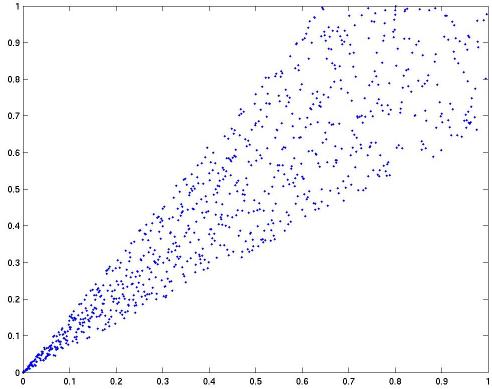
There is a fourth argument for "yes" which comes from the binary classification literature. If we solve hundreds of different classification problems, some of which are harder than others, we can compare directly how well one loss looks like another. The standard picture looks like that below:

On the x-axis is one loss function (say, hinge-loss) and on the y-axis is another (say, squared loss). Each dot corresponds to a different learning problem: those in the bottom left are easy, those in the top right are hard. What we commonly observe is that for very easy problems, it doesn't matter what loss you use (getting low error on one directly implies low error on another). However, as the problem gets harder, it makes a bigger and bigger difference which we use.

A confounding factor which even further argues for "yes" is that in the binary classification example, the losses used are ones for which zero loss in one always implies zero loss for the other. This is very much not the case for the sorts of losses we encounter in NLP.

So, my personal belief is that if we can optimize the more complicated loss, we always should, unless the problem is so easy that it is unlikely to matter (eg, part of speech tagging). But for any sufficiently hard problem, it is likely to make a big difference. Though I would love to see some results that do the same experiment that Franz did in his MT paper, but also with human evaluations.

23 May 2006

Penn Discourse TreeBank

I visited Penn last November and while talking with Joshi, I found out about a recent annotation effort from Penn/LDC: the Penn Discourse Treebank. (There is also an upcoming tutorial at ACL about the effort). The PDTB is quite different from discourse resources I'm familiar with (eg., the RST treebank). The interesting aspect of the PDTB is that discourse connectives (either those that appear explicitly or those that are implicit) are treated as a sort of predicate between two arguments, much like one would expect for verbs.

As someone who is interested in problems that break the sentence boundary, I find much discourse-related resources and work interesting. One nice thing about the PDTB is that, since not every sentence is required to relate to another (relation only occurs when it is clear), human agreement is high and many unnatural decisions made in the RST treebank are avoided (eg., forcing things to be a tree when they shouldn't be). One not-so-nice thing about the PDTB is that not every sentence is required to relate to another. In a theory of discourse, I am looking for something that tells me why this blog post is a text and why a string of largely unrelated sentences are not. The PDTB-style annotation does not give us this. Because of this, it is hard for me to imagine many applications for which this is incredibly useful.

In case anyone more familiar with the PDTB group reads this blog, I'm curious if anyone has proposed baseline models and evaluation criteria for this problem. I have some ideas if there isn't anything out there, but I don't want to step on toes...

21 May 2006

Getting Started In: Summarization

I'll kick off the "Getting Started In" series with summarization, since it is near and dear to my heart.

Warning: I should point out at the get-go that these posts are not intended to be comprehensive or present a representative sample of work in an area. These are blog posts, not survey papers, tutorials or anything of that sort. If I don't cite a paper, it's not because I don't think it's any good. It's also probably not a good idea to base a career move on what I say.

Summarization is the task of taking a long utterance (or a collection of long utterances) and producing a short utterance. The most common is when utterance=document, but there has also been work on speech summarization too. There are roughly three popular types of summarization: headline generation, sentence extraction and sentence compression (or document compression). In sentence extraction, a summary is created by selecting a bunch of sentences from the original document(s) and gluing them together. In headline generation, a very short summary (10 words or so) is created by selecting a bunch of words from the original document(s) and gluing them together. In sentence (document) compression a summary is created by dropping words and phrases from a sentence (document).

One of the big problems in summarization is that if you give two humans the same set of documents and ask them to write a summary, they will do wildly different things. This happens because (a) its unclear what information is important and (b) each human has different background knowledge. This is partially alleviated by moving to a task-specific setting, like the query-focused summarization model, which has grown increasingly popular in the past few years. In the query-focused setting, a document (or document collection) is provided along with a user query that serves to focus the summary on a particular topic. This doesn't fix problem (b), but goes a long way to fixing (a), and human agreement goes up dramatically. Another advantage to the query-focused setting is that, at least with news documents, the most important information is usually presented first (this is actually stipulated by many newspaper editor's guidelines). This means that producing a summary by just taking leading sentences often does incredibly well.

A related problem is that of evaluation. The best option is to do a human evaluation, preferably in some simulated real world setting. A reasonable alternative is to ask humans to write reference summaries and compare system output to these. The collection of Rouge metrics has been designed to automate this comparison (Rouge is essentially a collection of similarity metrics for matching human to system summaries). Overall, however, evaluation is a long-standing and not-well-solved problem in summarization.

Techniques for summarization vary by summary type (extraction, headline, compression).

The standard recipe for sentence extraction works as follows. A summary is created by first extracting the "best" sentence according to a scoring module. The second sentence is selected by finding the next-best sentence according to the scoring module, minus some redundancy penalty (we don't want to extract the same information over and over again). This process ends when the summary is sufficiently long. The scoring component assigns to each sentence in the original document collection a score that says how important it is (in query-focused summarization, for instance, the word overlap between the sentence and the query would be a start). The redundancy component typically computes the similarity between a sentence and the previously extracted sentences.

Headline generation and sentence compression have not yet reached a point of stability in the same way that sentence extraction has. A very popular and successful approach to headline generation is to train a hidden Markov model something like what you find in statistical machine translation (similar to IBM model 1, for those familiar with it). For sentence compression, one typically parses a sentence and then attempts to summarize it by dropping words and phrases (phrases = whole constituents).

Summarization has close ties to question answering and information retrieval; in fact, having some limited background in standard IR techniques (tf-idf, vector space model, etc.) are pretty much necessary in order to understand what goes on in summarization.

Here are some papers/tutorials/slides worth reading to get one started (I'd also recommend Inderjeet Mani's book, Automatic Summarization if you don't mind spending a little money):

  1. Background IR material
  2. Sentence extraction
    1. Marcu's ACL tutorial
    2. Multi-Document Summarization By Sentence Extraction
    3. Automated Multi-document Summarization in NeATS
    4. A Trainable Document Summarizer
  3. Headline generation: Automatic Headline Generation for Newspaper Stories
  4. Sentence compression: Statistics-Based Summarization --- Step One: Sentence Compression
  5. Other:
    1. Discussion: What might be in a summary?
    2. Automatic evaluation: ROUGE: a Package for Automatic Evaluation of Summaries
    3. Recent fun stuff: Cut and paste based text summarization, Learning to Paraphrase: An Unsupervised Approach Using Multiple-Sequence Alignment and A Statistical Approach for Automatic Speech Summarization

16 May 2006

Structured Prediction versus Multitask Learning

For a formal comparison, I will briefly define both SP and MTL:

A structured prediction problem is a distribution D over pairs (x,y), with x in X and y in Y, together with a loss function l(y,y'). Typically Y is large, and elements y have complex interdependent structured, which can be interpreted in various ways. The goal is a function f : X -> Y that minimizes the expect loss: E_{x,y ~ D}[l(y,f(x))].

A multitask learning problem is a distribution D over tuples (x,y,y1,...,yK), with x in X and (for simplicity) y,y1,...,yK all in 2={0,1}. The goal is a function f : X -> 2 that minimizes the expected loss: E_{x,y,y1,...,yK ~ D}[1(y != f(x))]. Importantly the loss doesn't care about y1...yK. However, we typically assume that y1...yK are related to the x -> y mapping.

Without assumptions on the SP loss or output space Y, SP subsumes MTL. For instance, in sequence labeling, we can think of a multitask learning problem as a sequence labeling problem where we only care about the label of the first word. This reminds me of some results that suggest that it's really not any easier to predict the first word in a translation than to solve the entire translation problem. This means that we could try to solve an MTL problem by applying, say, a CRF.

One key difference that seems quite important is that results from MTL have suggested that it is easy to get an MTL model that performs better on the first task, but its hard to get a single MTL model that performs well on all tasks simultaneously. For instance, in neural networks, one might want to run 1000 training epochs to do well on task 1, but only 10 or as many as 10000 to do well on one of the other tasks. This implies that it's probably not a good idea to naively apply something like a CRF to an MTL problem. For this reason (and the nature of the loss functions), I feel that SP and MTL are complementary problems.

The application of MTL to time-series data has been reportedly very successful. Time-series data is nice because it naturally provides additional tasks: in addition to predicting the value at time t, also predict at times t+5, t+10 and t+20. During training we have access to these values, but we don't during testing, so we don't have the option of using them as features.

One especially cool thing about this observation is that it applies directly to search-based structured prediction! That is, when attempting to make a prediction about some search step, we can consider future search steps to be related tasks and apply MTL techniques. For instance, when trying to predict the first word in a translation, we use the second and third words as related tasks. I, personally, think this would be quite a cool research project.

So my tentative conclusions are: (1) SP can solve MTL, but this is probably not a good idea. (2) MTL can be applied to search-based SP and this probably is a good idea. (3) SP and MTL should not be considered the same problem: the primary difference is the loss function, which is all important to SP, but not so important to MTL. That said, SP algorithms probably do get a bit of gain from the "good internal representation" learned in an MTL setting, but by trying to learn this representation directly, we could probably do much better.

14 May 2006

NLP is an Engineering Discipline?

At my graduation ceremony this past week, Dean Yannis Yortsos gave a short speech, in which he quoted someone famous (I've already forgotten who it was) at the Engineering graduation segment, saying something akin to "Science is the study of what the world is; Engineering is making something the world has never seen before." This comment had a fairly significant effect on me. However, when thinking about it in the context of NLP, it seems that NLP is an Engineering discipline, not a scientific one, at least according to the above (implied) definition of the terms.

NLP lives somewhere within the realm of language, statistics, machine learning, and cognitive science (you can include signal processing if you want to account for speech). Let's suppose that NLP is a scientific discipline: then, what aspect of the world does it study? It cannot be language, otherwise we'd be linguists. It cannot be statistics or learning, lest we call ourselves mathematicians. Cognitive science is out or we'd be...well, cognitive scientists. In fact, at least as I've described it in my job talks, NLP is the field that deals with building systems to solve problems that have a language component. This seems to render NLP to fall exclusively within the realm of Engineering.

This observation seems to have several repurcussions. It means, among other things, that we should not attempt to seek theoretical results, unless we are wearing another hat (I often wear the hat of a machine learning person; other people play linguists occasionally). It also means that perhaps we shouldn't complain as much that so much of NLP is system building. It seems that almost by definition, NLP must be system building: we are out to create things that never existed before.

If one, like me, is interested in science---that is, the study of natural things in the world---it also means that we had better find some related topic (machine learning, cognitive science or linguistics) to study simultaneously.

11 May 2006

ICML Accepted Papers Up

See here. I'm excited to see:

  • Bayesian Multi-Population Haplotype Inference (Xing, Sohn, Jordan + Teh)
  • Constructing Informative Priors using Transfer Learning (Raina, Ng + Koller)
  • Disciminative Unsupervised Learning of Structured Predictors (Xu, Wilkinson, Southey + Schuurmans)
  • Maximum Margin Planning (Ratliff, Bagnell + Zinkevich)
  • Pachinko Allocation (Li + McCallum)
  • Semi-supervised Learning for Structured Output Variables (Brefeld + Scheffer)
  • Topic Modeling: Beyond Bag-of-Words (Wallach)