29 April 2007

Problems with Sometimes-hidden Variables

Following in the footsteps of Andrew, I may start posting NLP-related questions I receive by email to the blog (if the answer is sufficiently interesting). At least its a consistent source of fodder. Here's one from today:

I am looking for a task, preferably in nlp and info retriv, in which we have labeled data where some are completely observed (x,h) and some are partially observed x. (h is a latent variable and is observed for some data points and not observed for others) Briefly, the data should be like {(x_i,h_i,y_i),(x_j,y_j)} where y is the class label.
I think there are a lot of such examples. The first one to spring to mind is alignments for MT, but please don't use the Aachen alignment data; see Alex's ACL06 paper for one way to do semi-supervised learning when the majority of the work is coming from the unsupervised part, not from the supervised part. You could try to do something like the so-called end-to-end system, but with semi-supervised training on the alignments. Of course, building an MT system is a can of worms we might not all want to open.

Depending on exactly what you're looking for, there may be (many) other options. One might be interested in the case where the ys are named entity tags or entities with coref annotated and the hs are parse trees (ala the BBN corpus). By this reasoning, pretty much any pipelined system can be considered of this sort, provided that there is data annotated for both tasks simultaneously (actually, I think a very interesting research question is what to do when this is not the case). Unfortunately, typically if the amount of annotated data differs between the two tasks, it is almost certainly going to be the "easier" task for which more data is available, and typically you would want this easier task to be the hidden task.

Other than that, I can't think of any obvious examples. You could of course fake it (do parsing, with POS tags as the hidden, and pretend that you don't have fully annotated POS data, but I might reject such a paper on the basis that this is a totally unrealistic setting -- then again, I might not if the results were sufficiently convincing). You might also look at multitask learning literature; I know that in such settings, it is often useful to treat the "hidden" variable as just another output variable that's sometimes present and sometimes not. This is easiest to do in the case of neural networks, but can probably be generalized.

27 April 2007

EMNLP papers, tales from the trenches

First, EMNLP/CoNLL papers have been posted. I must congratulate the chairs for publishing this so fast -- for too many conferences we have to wait indefinitely for the accepted papers to get online. Playing the now-standard game of looking at top terms, we see:

  1. model (24)
  2. translat (17)
  3. base (16)
  4. learn (13) -- woohoo!
  5. machin (12) -- mostly as in "machin translat"
  6. word (11) -- mostly from WSD
  7. structur (10) -- yay, as in "structured"
  8. disambigu (10) -- take a wild guess
  9. improv (9) -- boring
  10. statist, semant, pars, languag, depend, approach (all 7)
EMNLP/CoNLL this year was the first time I served as area chair for a conference. Overall it was a very interesting and enlightening experience. It has drastically changed my view of the conference process. I must say that overall it was a very good experience: Jason Eisner did a fantastic job at keeping things on track.

I want to mention a few things that I noticed about the process:
  1. The fact that reviewers only had a few weeks, rather than a few months to review didn't seem to matter. Very few people I asked to review declined. (Thanks to all of you who accepted!) It seems that, in general, people are friendly and happy to help out with the process. My sense is that 90% of the reviews get done in the last few days anyway, so having 3 weeks or 10 weeks is irrelevant.

  2. The assignment process of papers to reviewers is hard, especially when I don't personally know many of the reviewers (this was necessary because my area was broader than me). Bidding helps a lot here, but the process is not perfect. (People bid differently: some "want" to review only 3 papers, so "want" half...) If done poorly, this can lead to uninformative reviews.

  3. Papers were ranked 1-5, with half-points allowed if necessary. None of my papers got a 5. One got a 4.5 from one reviewer. Most got between 2.5 and 3.5, which is highly uninformative. I reviewed for AAAI this year, where you had to give 1,2,3 or 4, which forces you to not abstain. This essentially shifts responsibility from the area chair to the reviewer. I'm not sure which approach is better.

  4. EMNLP asked for many criteria to be evaluated by reviewers; more than in conferences past. I thought this was very useful to help me make my decisions. (Essentially, in addition to high overall recommendation, I looked for high scores on "depth" and "impact.") So if you think (like I used to) that these other scores are ignored: be assured, they are not (unless other area chairs behave differently).

  5. Blindness seems like a good thing. I've been very back and forth on this until now. This was the first time I got to see author names with papers and I have to say that it is really hard to not be subconsciously biased by this information. This is a debate that will never end, but for the time being, I'm happy with blind papers.

  6. 20-25% acceptance rate is more than reasonable (for my area -- I don't know about others). I got 33 papers, of which three basically stood out as "must accepts." There were then a handful over the bar, some of which got in, some of which didn't. There is certainly some degree of randomness here (I believe largely due to the assignment of papers to reviewers), and if that randomness hurt your paper, I truly apologize. Not to belittle the vast majority of papers in my area, but I honestly don't think that the world would be a significantly worse place is only those top three papers had gotten in. This would make for a harsh 9% acceptance rate, but I don't have a problem with this.

    I know that this comment will probably not make me many friends, but probably about half of the papers in my area were clear rejects. It seems like some sort of cascaded approach to reviewing might be worth consideration. The goal wouldn't be to reduce the workload for reviewers, but to have them concentrate their time on papers that stand a chance. (Admittedly, some reviewers do this anyway internally, but it would probably be good to make it official.)

  7. Discussion among the reviewers was very useful. I want to thank those reviewers who added extra comments at the end to help me make the overall decisions (which then got passed up to the "higher powers" to be interpolated with other area chair's decisions). There were a few cases where I had to recruit extra reviewers, either to get an additional opinion or because one of my original reviewers went AWOL (thanks, all!). I'm happy to say that overall, almost all reviews were in on time, and without significant harassment.
So that was my experience. Am I glad I did it? Yes. Would I do it again? Absolutely.

Thanks again to all my reviewers, all the authors, and especially Jason for doing a great job organizing.

19 April 2007

Searn versus HMMs

Searn is my baby and I'd like to say it can solve (or at least be applied to) every problem we care about. This is of course not true. But I'd like to understand the boundary between reasonable and unreasonable. One big apparently weakness of Searn as it stands is that it appears applicable only to fully supervised problems. That is, we can't do hidden variables, we can't do unsupervised learning.

I think this is a wrong belief. It's something I've been thinking about for a long time and I think I finally understand what's going on. This post is about showing that you can actually recover forward-backward training of HMMs as an instance of Searn with a particular choice of base classifier, optimal policy, loss function and approximation method. I'll not prove it (I haven't even done this myself), but I think that even at a hand-waving level, it's sufficiently cool to warrant a post.

I'm going to have to assume you know how Searn works in order to proceed. The important aspect is essentially that we train on the basis of an optimal policy (which may be stochastic) and some loss function. Typically I've made the "optimal policy" assumption, which means that when computing the loss for a certain prediction along the way, we approximate the true expected loss with the loss given by the optimal policy. This makes things efficient, but we can't do it in HMMs.

So here's the problem set up. We have a sequence of words, each of which will get a label (for simplicity, say the labels are binary). I'm going to treat the prediction task as predicting both the labels and the words. (This looks a lot like estimating a joint probability, which is what HMMs do.) The search strategy will be to first predict the first label, then predict the first word, then predict the second label and so on. The loss corresponding to an entire prediction (of both labels and words) is just going to be the Hamming loss over the words, ignoring the labels. Since the loss doesn't depend on the labels (which makes sense because they are latent so we don't know them anyway), the optimal policy has to be agnostic about their prediction.

Thus, we set up the optimal policy as follows. For predictions of words, the optimal policy always predicts the correct word. For predictions of labels, the optimal policy is stochastic. If there are K labels, it predicts each with probability 1/K. Other optimal policies are possible and I'll discuss that later.

Now, we have to use a full-blown version of Searn that actually computes expected losses as true expectations, rather than with an optimal policy assumption. Moreover, instead of sampling a single path from the current policy to get to a given state, we sample all paths from the current policy. In other words, we marginalize over them. This is essentially akin to not making the "single sample" assumption on the "left" of the current prediction.

So what happens in the first iteration? Well, when we're predicting the Nth word, we construct features over the current label (our previous prediction) and predict. Let's use a naive Bayes base classifier. But we're computing expectations to the left and right, so we'll essentially have "half" an example for predicting the Nth word from state 0 and half an example for predicting it from state 1. For predicting the Nth label, we compute features over the previous label only and again use a naive Bayes classifier. The examples thus generated will look exactly like a training set for the first maximization in EM (with all the expectations equal to 1/2). We then learn a new base classifier and repeat.

In the second iteration, the same thing happens, except now when we predict a label, there can be an associated loss due to messing up future word predictions. In the end, if you work through it, the weight associated with each example is given by an expectation over previous decisions and an expectation over future decisions, just like in forward-backward training. You just have to make sure that you treat your learned policy as stochastic as well.

So with this particular choice of optimal policy, loss function, search strategy and base learner, we recover something that looks essentially like forward-backward training. It's not identical because in true F-B, we do full maximization each time, while in Searn we instead take baby steps. There are two interesting things here. First, this means that in this particular case, where we compute true expectations, somehow the baby steps aren't necessary in Searn. This points to a potential area to improve the algorithm. Second, and perhaps more interesting, it means that we don't actually have to do full F-B. The Searn theorem holds even if you're not computing true expectations (you'll just wind up with higher variance in your predictions). So if you want to do, eg., Viterbi F-B but are worried about convergence, this shows that you just have to use step sizes. (I'm sure someone in the EM community must have shown this before, but I haven't seen it.)

Anyway, I'm about 90% sure that the above actually works out if you set about to prove it. Assuming its validity, I'm about 90% sure it holds for EM-like structured prediction problems in general. If so, this would be very cool. Or, at least I would think it's very cool :).

17 April 2007

ACL papers up

List is here.

Top stemmed, non-stop words from titles are:

  • Model (22)
  • Tranlat (16)
  • Languag (16)
  • Machin (15)
  • Learn (15)
  • Base (14) -- as in "syntax-based"
  • Word (13)
  • Statist (13)
  • Pars (11) -- as in parsing
  • Semant (10) -- wow!
  • Approach (10)

12 April 2007

Multinomial on a graph

I'm going to try something here to see if it works; my guess is not, but maybe it will at least spark some discussion. (I'm also testing LaTeX in Blogger.) In "text modeling" applications, we're usually dealing with lots of multinomials, especially multinomials over our vocabulary (i.e., unigram language models). These are parameterized by a vector of length equal to the size of the vocabulary. should be the probability of seeing word . The probability of observing an entire document of length , containing copies of word 1, copies of word 2, and so on, is:


What I'm interested in is extensions to this where we don't assume independence. In particular, suppose that we have an ontology. Let's say that our ontology is just some arbitrary graph. What I want is a distribution that essentially prefers to keep drawing values "locally" within the graph. That is, if I've already drawn "computer" then I'm not so suprised to also see "program."

One way of thinking about this is by having a sort of random walk model. Think about placing the individual s on the graph and then allowing them to disperse. So that maybe there is some for which (and the rest are zero). We certainly want our distribution to prefer draws for word , but draws of word where is "near" should also be acceptable.

My first cut attempt at this is as follows. Let be a graph over our vocabulary; let be a neighborhood of (maybe, all nodes within 10 steps); let be the inverse neighborhood (the set of all that have in ). Let be the distance between two nodes and let be a dampening parameter (how fast probability diffuses on the graph). Define our probabilistic model as:


Where we let .

The idea behind this model is as follows. When we observe word i, we have to assign a probability to it. This probability is given by any node j that contains i in its neighborhood. Each such node has some mass which it can distribute. It distributes this mass proportional to to all nodes , where serves to normalize this diffusion.

I'm pretty sure that the normalizing constant for this distribution is the same as the multinomial. After all, there is a one-to-one mapping between the multinomial parameters and the "graph multinomial" parameters, so we should still get to normalize.

Now, because I feel an incredible need to be Bayesian, I need a conjugate prior for this "graph multinomial" distribution. Since the graph multinomial is essentially just a reparameterization of the standard multinomial, it seems that a vanilla Dirichlet would be an appropriate prior. However, I cannot prove that it is conjugate -- in particular, I can't seem to come up with appropriate posterior updates.

So this is where y'all come in to save the day! I can't imagine that no one has come up with such a "graph multinomial" distribution -- I just don't know what keywords to search for. If someone has seen something at all like this, I'd love to know. Alternatively, if someone can tell me what the appropriate conjugate prior is for this distribution, plus the posterior update rules, that would also be fantastic.

07 April 2007

AI Stats post mortem

Got back from AIStats a week or so ago; overall, I enjoyed it. Though by the end, I was totally sick of Puerto Rican food. (I'm a huge fan of Cuban food and expected stronger similarities. Oh well.) Here are some things I learned at AIStats:

  • Multiple instance learning. There was a paper on this topic. I can't comment on how good the paper was (in comparison to other MIL papers), but I didn't know about the MIL task before. The problem is as follows. Instead of getting a set of labeled training points, you get a set of sets of points. Each set of points comes with a +1/-1 label. +1 means that at least one example in the set is positive; -1 means none are. Vision people like this because they have an image that contains a person but they don't know where the person is, so the scan a box around the image and generate lots of examples. We know at least one will contain a person. I realized after seeing the poster that I've actually worked on this problem! The BayeSum paper is actually a MIL algorithm, but I didn't know the right terminology. I wonder how it compares in vision problems.
  • Deep belief networks. These seem to be growing in popularity -- both Hinton's group and LeCun's group have their own version of DBNs. You can basically think of these as neural nets with tons of layers of hidden units. They can presumably learn really complicated functions of inputs. It's also possible to train them unsupervisedly (is that a word?) and then just tune the unsupervised model to some classification task. I don't really understand how they work, but they seem to be doing something interesting.
  • It is possible to learn (probably approximate) underestimates for the heuristic in A* search. The problem is that you have a given, fixed path cost and you want to learn an admissible heuristic. Seems quite similar to Berkeley paper at NAACL this year, though different in important ways. Seems like a reasonable thing to try if you're stuck with a fixed path cost. I'm curious how these techniques compare to keeping a heuristic fixed and learning a path cost, ala Drew -- seems that on the surface they'd be similar, but learning the path cost seems a bit easier to me.
There were, of course, other interesting papers. Yee Whye has listed a few.

05 April 2007

Discourse is darn hard

Discourse is an area I've been peripherally interested in for quite a while; probably unduly influence by my advisor's (ex-?)interest in the problem. The general sense I get is that discourse relations are relatively easy to identify when cue-phrases exist. This is essentially the approach taken by the Penn Discourse Treebank and Daniel's original parser. Unfortunately, cue phrases exist only for a small subset of sentences, so it's tempting to look at lexical techniques, since they work so well in other problems. The intuition is that if one sentence says "love" and the next says "hate," then maybe they are in some sort of contrastive relation. Unfortunately, the world is rarely this nice. The amount of inference necessary to reliably identify seemingly simple, coarse-grained relationships, seems astonishing.

Here are some examples of contrast relations:

  1. The interest-only securities will be sold separately by BT Securities.
    The principal-only securities will be repackaged by BT Securities into a Freddie Mac Remic, Series 103, that will have six classes.
  2. James Earl Jones is cast to play the Rev. Mr. Johns.
    The network deals a lot with unknowns, including Scott Wentworth, who portrayed Mr. Anderson, and Bill Alton as Father Jenco.
  3. At the same time, second-tier firms will continue to lose ground.
    In personal computers, Apple, Compaq and IBM are expected to tighten their hold on their business.
In (1), we need to know that interest-only and principal-only securities are essentially themselves contrastive. We then need to combine this information with the coreference of BT Securities in both cases (should be easy). This seems like maybe we could possibly get it with enough data. For (2), we essentially need to know that James Earl Jones is famous, and that "deals with unknowns" is the same as "casts." For (3), we need to know that Apple, Compaq and IBM are not second-tier firms. These latter two seem quite difficult.

Next, let's consider background. Here are some short examples of background relations:
  1. The March 24 oil spill soiled hundreds of miles of shoreline along Alaska's southern coast and wreaked havoc with wildlife and the fishing industry.
    Exxon Corp. is resigning from the National Wildlife Federation 's corporate advisory panel, saying the conservation group has been unfairly critical of the Exxon Valdez oil spill along the Alaskan coast.
  2. Insurers typically retain a small percentage of the risks they underwrite and pass on the rest of the losses.
    After Hugo hit, many insurers exhausted their reinsurance coverage and had to tap reinsurers to replace that coverage in case there were any other major disasters before the end of the year.
The first example here might be identifiable by noting that the tense in the two sentences is different: one is present, one is past. Beyond this, however, we'd essentially have to just recognize that the oil spill referred to in both sentences is, in fact, the same spill. We'd have to infer this from the fact that otherwise the first sentence is irrelevant. In (2), we'd have to recognize that the "passed on" losses go to reinsurers (I didn't even know such things existed).

As a final example, let's look at some evidence relations:
  1. A month ago, the firm started serving dinner at about 7:30 each night; about 50 to 60 of the 350 people in the investment banking operation have consistently been around that late.
    Still, without many actual deals to show off, Kidder is left to stress that it finally has "a team" in place, and that everyone works harder.
  2. Yesterday, Mobil said domestic exploration and production operations had a $16 million loss in the third quarter, while comparable foreign operations earned $234 million.
    Individuals familiar with Mobil's strategy say that Mobil is reducing its U.S. work force because of declining U.S. output.
These examples also seem quite difficult. In (1), the fact that the "team" is supposed to refer to the "50 to 60 ... people" and that having dinner, within the context of a company, is a "team-like" activity. (2) is somewhat easier -- knowing that a "loss" is related to a "decline" helps a lot, though it is entirely possible that the type of relation would differ. You also pretty much have to know that "domestic" means "U.S."

I feel like, in many ways, this discourse relation problem subsumes the now-popular "textual entailment" problem. In fact, some of the RST relations look a lot like textual entailment: elaboration-general-specific, eleboration-set-member, Contrast (as a negative entailment), consequence, etc.

I don't have a strong conclusion here other than: this is a hard problem. There've been some attempts at learning lexical things for this task, but I feel like it needs more than that.

04 April 2007

Very Sad News

Karen Sparck-Jones passed away this morning. You can find more information about her here and in many other places on the web. I, personally, remember Karen as endlessly enthusiastic and always willing to push me to think about problems in new (and interesting) lights. She's been immensely important in both NLP and IR, and her death is an enormous loss to the field; I have greatly valued her contributions in DUC discussions, among other things. Many will miss her.

I'll leave this discussion with a quote from an email I have from her from only a few weeks ago, since I think it's something we should all think about, whatever our context:

Document collections is a much misumnderstood topic -- you have to think what its for and eg where (in retrieval) you are going to get real queries from. Just assembling some bunch of stuff and saying hey giys, what would you like to do with this is useless.

31 March 2007

Poker Face

Apologies for the long silence -- life got in the way. Part of life was AIstats, which I'll blog about shortly, but I'm waiting for them to get the proceedings online so I can (easily) link to papers.

A common (often heated) argument in the scientific community is the "blind" versus "not-blind" review process -- i.e., can the reviewers see the identity of the authors. Many other bloggers have talked about this in the past (here and here, for instance). I don't want to talk about this issue right now, but rather one specific consequence of it that I don't think actually need to be a consequence. But if often is. And I think that more than anything else, it does serve to hurt research.

Recent anecdote: Less than a month ago, I was talking with my friend John Blitzer at UPenn recently over email about domain adaptation stuff. We both care about this problem and have worked on different angles of it. Initially we were talking about his NIPS paper, but the discussion diffused into more general aspects of the problem. I had been at the time working furiously on a somewhat clever, but overall incredibly simply approach to domain adaptation (managed to make it in to ACL this year -- draft here). The interesting thing about this approach was that it completely went against the theoretical bounds in his paper (essentially because those are crafted to be worst case). It doesn't contradict the bounds of course, but it shows the good adaptation is possible in many cases when the bounds give no information.

Of course I told him about this, right? Well, actually, no. I didn't. In retrospect this was stupid and a mistake, but it's a stupid mistake I've made over and over again. Why did I do this? Because at the time I knew that the paper was on its way to ACL -- perhaps I had even submitted at that point; I cannot remember. And if he happened to be one of the reviewers on it, then he would obviously know it was me and then the "double blind" aspect of ACL would be obviated. Or---perhaps worse---he would have marked it as a conflict of interest (though indeed I don't think it was) because he knew my identity. And then I would have lost the opinion of a pretty smart guy.

All this is to say: I think there's often a temptation not to talk about ongoing research because of the double-blind rule. But this is ridiculous because the people who are close to you in research area are exactly those to whom you should talk! I don't think the solution has anything to do with reversing double-blind (though that would solve it, too). I think the solution is just to realize that in many cases we will know the authorship of a paper we review, and we shouldn't try so hard to hide this. Hiding it only hinders progress. We should talk to whomever we want about whatever we want, irregardless of whether this person may or may not review a paper on the topic later. (As a reviewer, their identity is hidden anyway, so who cares!)

(Briefly about conflict of interest. I used to be somewhat liberal in saying I had a COI for a paper if I knew who the author was. This is a bad definition of COI, since it means that I have a COI with nearly every paper in my area(s). A true COI should be when I have something to gain by this paper being published. E.g., it is written by my advisor, student, or very very very close colleauge -- i.e., one with whom I publish regularly, though even that seems a bit of a stretch.)

10 March 2007

Reproducible Results

In an ideal world, it would be possible to read a paper, go out and implement the proposed algorithm, and obtain the same results. In the real world, this isn't possible. For one, if by "paper" we mean "conference paper," there's often just not enough space to spell out all the details. Even how you do tokenization can make a big difference! It seems reasonable that there should be sufficient detail in a journal paper to achieve essentially the same results, since there's (at least officially) not a space issue. On the other hand, no one really publishes in journals in our subfamily of CS.

The next thing one can do is to release the software associated with a paper. I've tried to do this in a handful of cases, but it can be a non-trivial exercise. There are a few problems. First, there's the question of how polished the software you put out should be. Probably my most polished is megam (for learning classifiers) and the least polished is DPsearch (code from my AI stats paper). It was a very nontrivial amount of effort to write up all the docs for megam and so on. As a result, I hope that people can use it. I have less hope for DPsearch --- you'd really have to know what you're doing to rip the guts out of it.

Nevertheless, I have occasionally received copies of code like my DPsearch from other people (i.e., unpolished code) and have still been able to use them successfully, albeit only for ML stuff, not for NLP stuff. ML stuff is nice because, for the most part, its self-contained. NLP stuff often isn't: first you run a parser, then you have to have wordnet installed, then you have to have 100MB of data files, then you have to run scripts X, Y and Z before you can finally run the program. The work I did for my thesis is a perfect example of this: instead of building all the important features into the main body of code I wrote, about half of them were implemented as Perl scripts that would essentially add "columns" to a CoNLL-style input format. At the end, the input was like 25-30 columns wide, and if any were missing or out of order, bad things would happen. As a result, it's a completely nontrivial exercise for me to release this beast. The only real conceivable option would be to remove the non-important scripts, get the important ones back into the real code, and then release that. But then there's no way the results would match exactly those from the paper/thesis.

I don't know of a solution to this problem. I suppose it depends on what your goal is. One goal is just to figure out some implementation details so that you can use them yourself. For this, it would be perfectly acceptable in, say, my thesis situation, to just put up the code (perhaps the scripts too) and leave it at that. There would be an implicit contract that you couldn't really expect too much from it (i.e., you shouldn't expect to run it).

A second goal is to use someone else's code as a baseline system to compare against. This goal is lessened when common data is available, because you can compare to published results. But often you don't care about the common data and really want to see how it works on other data. Or you want to qualitatively compare your output to a baseline. This seems harder to deal with. If code goes up to solve this problem, it needs to be runnable. And it needs to achieve pretty much the same results as published, otherwise funny things happen ("so and so reported scores of X but we were only able to achieve Y using their code", where Y < X). This looks bad, but is actually quite understandable in many cases. Maybe the solution here is, modulo copyright restrictions and licensing problems (ahem, LDC), just put up you models output as well. This doesn't solve the direct problem, but maybe helps a bit. It also lets people see where you model screws up, so they can attempt to fix those problems.

28 February 2007

Loss Functions for Chunking Tasks

I feel like this is starting to be a bit of dead horse, but I wanted to follow up a bit on previous posts talking about f-score versus accuracy for chunking problems.

An easy observation is that if you have a chunking problem for which the majority of the chunks are multi-word tokens, then it is possible to get a model that achieves quite good accuracy, but abysmal f-score. Of course, real world taggers may not actually do this. What I wanted to know was the extent to which accuracy, f-score and ACE score are not correlated when used with a real world tagger.

Here's the experiment. I use TagChunk for all the experiments. I do experiments on both syntactic chunking (CoNLL data) and NER (also CoNLL data), both in English. In the experiments, I vary (A) the amount of training data used, (B) the size of the beam used by the model, (C) the number of iterations of training run. When (A) is varied, I run five sets of training data, each randomly selected.

The data set sizes I used are: 8, 16, 32, 64, 125, 250, 500, 1000, 2000, 4000 and 8000. (There are number of sentences, not words. For the NER data, I remove the "DOCSTART" sentences.) The beam sizes I use are 1, 5 and 10. The number of iterations is from 1 to 10.

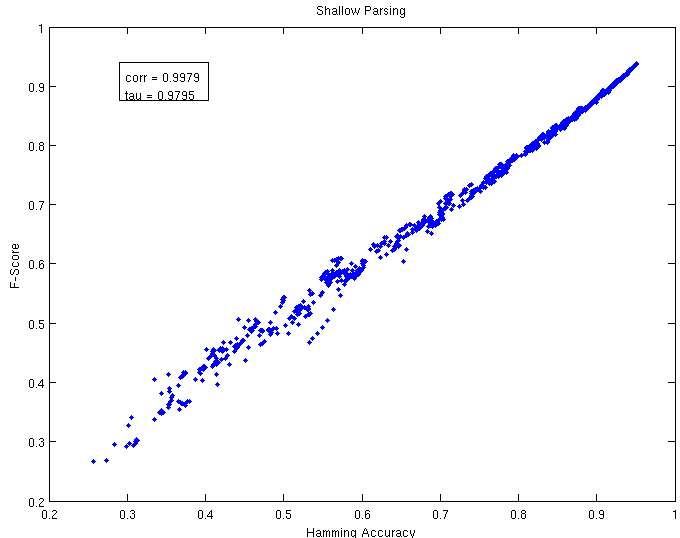
For the chunking problem, I tracked Hamming accuracy and f-score (on test) in each of these settings. These are drawn below (click on the image for a bigger version):


As we can see, the relationship is ridiculously strongly linear. Basically once we've gotten above an accuracy of 80%, it would be really really hard to improve accuracy and not improve F-score. The correlation coefficient for this data is 0.9979 and Kendall's tau is 0.9795, both indicating incredibly strong correlation (formal caveat: these samples are not independent).

For the NER task, I do the same experiments, but this time I keep track of accuracy, F-score and (a slightly simplified version of) the ACE metric. The results are below (again, click for a bigger version):


The left-most image is accuracy-versus-F, the middle is accuracy-versus-ACE and the right is F-versus-ACE. The ACE seems to be the outlier: it produces the least correlation. As before, with accuracy-to-F, we get a ridiculously high correlation coefficient (0.9959) and tau (0.9761). This drops somewhat when going to accuracy-to-ACE (corr=0.9596 and tau=0.9286) or to F-to-ACE (corr=0.9715 and tau=0.9253).

Nevertheless, the majority of the non-linearity occurs in the "very low accuracy" region. Here, that region is in the 0.8-0.9 range, not the 0.1-0.5 range as in chunking. This is because in chunking, almost every word is in a chunk, whereas in NER there are a ton of "out of chunk" words.

The take-away from these experiments is that it seems like, so long as you have a reasonably good model (i.e., once you're getting accuracies that are sufficiently high), it doesn't really matter what you optimize. If your model is terrible or if you don't have much data, then it does. It also seems to make a much bigger difference if the end metric is F or ACE. For F, it's pretty much always okay to just optimize accuracy. For ACE, it's not so much, particularly if you don't have sufficient data.

25 February 2007

Language and X

I feel it is increasingly interesting to look at problems that have both a linguistic and a non-linguistic signal. The simplest example I can think of here is recent work in looking at images and their captions (eg., the matching words and pictures approach, though this is not the only such example). The idea in many of these techniques is that we have a single data set that contains two types of data. One is language (eg., the captions) and the other is something else (eg., the images). There are many other potentially interesting sources of data like this that I'll discuss after saying why I think these problems are interesting.

I think there are two basic reasons why such "dual" problems are interesting:

  1. By looking at multiple modalities, we can get cross-modality reinforcement of what we're learning. I think a great example of that is this paper, which uses face recognition together with textual coreference in order to do unsupervised coref in captions. The idea is that if you can tell that two different pictures contain the entity we call "Bill Clinton" in them, then it's more likely that a name in their caption will corefer. This gives us a greater ability to share data across a single data set.
  2. When language is treated in the context of some other source of information, we get a sort of grounding effect. That is, continuing the coref example from #1, we have--in some sense--grounded the string "Bill Clinton" to a pictorial representation of a person. Sure, this representation is still just a bunch of symbols, but they're markedly different symbols from the ones we use to represent the entity in purely linguistic terms. Perhaps hard-core cognitive scientists wouldn't call this grounding, but it's getting there. (Also along these lines, one of my favorite papers from a few years ago was my ex-ISI friend Mike doing grounding by looking and language and action in video games.)
There are probably other reasons why such tasks are interesting, but these are the two that appeal to me most strongly.

It seems that vision+language is the hot topic, or at least the warmest of the bunch. This is probably because vision people and language people tend to overlap and meet at machine learning conferences. It's probably also because the sorts of techniques used by the two communities are perhaps the most similar. But I think there's lots of room for looking at other "X"s. For instance, biology. There are lots of data sets (eg., GEO) that contain textual information ("these are cell lines depicting ovarian cancer") plus the actual cell lines. Heck, many papers in PubMed contain such information, albeit in figures rather than matrices. Robotics is another option. Ray Mooney's group down in Texas has worked at understanding orders given to robocup competitors based on language information (eg., this paper). Perhaps the oldest that actually lives within the NLP community is NLP + databases, which we really haven't seen much of in the past 5-10 years.

I think this is an interesting and fruitful area of future research and is one that I'll probably be exploring myself (but I won't give away what "X"s!).

13 February 2007

I Don't Think We Understand Structured Prediction

I've posted on structured prediction a few times before and then some. This is another post, but with a different perspective. Besides, the most recent time was last May, so it's been a while. This post is prompted by a recent OpEd by John Lafferty and Larry Wasserman on Challenges in Machine Learning in Statistica Sinica, where they mention SP as one of three major open questions in machine learning (the other two are semi-sup and sparse learning in high dimensions).

I've been trying to think of a good way of ontologizing SP methods recently, primarily because I want to understand them better. The more I think about it, the more I feel like we really don't understand the important issues. This is partially evidenced by an observation that in the past six years (essentially, since the first CRF paper), there have been like 30 different algorithms proposed for this problem. The fact that there are so many proposed algorithms tells me that we don't really understand what's going on, otherwise we wouldn't need to keep coming up with new techniques. (I'm not innocent.)

To me, the strongest division between techniques is between techniques that require tractable inference in the underlying problem (eg, CRFs, M3Ns, SVM-struct, structured perceptron, MIRA, MEMMs, HMMs, etc.) and those that don't (eg, incremental perceptron, LaSO, Searn, the Liang/Lacoste-Julien/Klein/Taskar MT algorithm, local predictors ala Roth and colleagues, etc.). Whether this truly is the most important distinction is unclear, but to me it is. I think of the former set as a sort of "top down" or "technology-push" techniques, while the latter are a sort of "bottom up" or "application-pull" techniques. Both are entirely reasonable and good ways of going at looking at the problem, but as of now the connections between the two types are only weakly understood.

An alternative division is between generative techniques (HMMs), conditional methods (CRFs) and margin-based techniques (everything else, minus Searn which is sort of non-committal with respect to this issue). I don't really think this is an important distinction, because with the exception of generative being quite different, conditional methods and margin-based methods are essentially the same in my mind. (Yes, I understand there are important differences, but it seems that in the grand scheme of things, this is not such a relevant distinctions.)

A related issue is whether the algorithms admit a kernelized version. Pretty much all do, and even if not, I also don't see this as a very important issue.

There are other issues, some of which are mentioned in the Lafferty/Wasserman paper. One is consistency. (For those unfamiliar with the term, a consistent algorithm is essentially one that is guaranteed to find the optimal solution if given infinite amounts of data.) CRFs are consistent. M3Ns are not. Searn is not, even if you use a consistent classifier as the base learning algorithm. My sense is that to statisticians, things like consistency matter a lot. In practice, my opinion is that they're less important because we never have that much data.

Even within the context of techniques that don't require tractability, there is a great deal of variation. To my knowledge, this family of techniques was essentially spawned by Collins and Roark with the incremental perceptron. My LaSO thing was basically just a minor tweak on the IP. Searn is rather different, but other published methods are largely other minor variants on the IP and/or LaSO, depending on where you measure from. And I truly mean minor tweaks: the essentially difference between LaSO and IP is whether you restart your search at the truth when you err. Doing restarts tends to help, and it lets you prove a theorem. We later had a NIPS workshop paper that restarted, but allowed the algorithm to take a few steps off the right path before doing so. This helped experimentally and also admitted another theorem. I've seen other work that does essentially the same thing, but tweaks how updates are done exactly and/or how restarts happen. The fact that we're essentially trying all permutations tells me that many things are reasonable, and we're currently in the "gather data" part of trying to figure out the best way to do things.

10 February 2007

AI-Stats schedule/papers up

The papers weren't listed in a single location, so I assembled them in one page. Looks like it should be fun (and sunny)!

05 February 2007

Bag of Words citation

I was recently asked by a colleague if I knew what the first paper was that used the bag of words model. I'm pretty certain it would be an IR paper, but have no idea what I would be. Manning+Schutze and Jurafsky+Martin don't have it. I know tf-idf is due to Sparck-Jones, but I presumably BOW existed before that. The vector space model is often credited to Salton, which is probably the earliest thing I know of, but my guess is that BOW predated even that. Anyone know a citation?

03 February 2007

To err is human, but what about researchers?

Errors happen and sometimes get in to papers. A recent example is the JAIR paper I had with Daniel on Domain Adaptation last year. I actually didn't catch the error myself -- it was caught by someone who was reimplementing the technique. And it's a totally not-insignificant error: essentially, the update equation for the generative parameters is completely botched. If you look through the derivation in the Appendix, it's clear where the error crept in.

Thankfully, this sort of error is essentially a typo. That is, the error was introduced when I was typing up the paper, not when I was doing the research. Why this is important is that it means the the implementation reflects the correct updates: only the paper has the mistake. This means that the experimental results from the paper are valid, contingent on the fact that you rederive the updates yourself, or just ask me what they should be.

I'm writing this post because it's somewhat unclear what to do when such a thing arises. One temptation is to do nothing. I have to admit that I was completely embarrassed when this was pointed out to me. There was a part of me that wanted to ignore it. It seems that this is the wrong approach for a variety of reasons, not the least of which is to make sure that correct information does get out. The question, to some degree, is exactly how to do this. I have a blog, which means I can write an entry like this. I can also put an errata on my web page that points out the errors (I'm writing this up as we "speak"). Given that this is a pub in an online journal, I believe I am able to submit updates, or at least additional appendices, which means that the "official version" can probably be remedied.

But what about conference pubs? If this had appeared in ACL and I didn't have a blog, the situation would be something different (ironically, an earlier version with the correct updates had been rejected from ACL because the derivations were omitted for space and two reviewers couldn't verify them). Also, what if someone hadn't pointed it out to me? I certainly wouldn't have noticed -- that paper was behind me. But then anyone who noticed the errors might dismiss the results on the grounds that they could assume that the implementation was also incorrect (it's not inconceivable that an erroneous implementation can still get good results). This would also not be good because the idea in the paper (any paper with such errors) might actually be interesting.

False things are published all the time. The STOC/FOCS community (i.e., theory community) has a handful of examples...for them, errors are easy to identify because you can prove the opposite of any theorem. I recall hearing of a sequence of several papers that incrementally used results from a previous, but the first was in error, putting the rest in error (I also recall hearing that many of the subsequent results could be salvaged, despite the ancestral mistake).

I don't know if there's a good solution, given our publication mechanisms (essentially, publish-once-then-appear-in-the-anthology). But I'm pretty sure mine is not the first paper with such errors. At least I hope not :).

28 January 2007

Good News on ACL Reviews

I'm reviewing for ACL again this year (in the machine learning subcomponent). A couple of days ago, I received my notice to start bidding on papers (more on bidding below). The email came with the following note:

Naturally, reviewers have been chosen to assess papers based on their own expertise and outlook. Having said this, we are aware that ACL has sometimes been perceived, especially in recent years, as overemphasizing the pursuit of small incremental improvements of existing methods, perhaps at the expense of exciting new developments. (ACL is solid but boring, is what some people would say.) While we believe that it would be counterproductive to change course radically -- We certainly would not want to sacrifice solidity! -- we would like to encourage you, as a reviewer, to look out particularly for what's novel and interesting, even if this means accepting a paper that has one or two flaws, for example because it has not been evaluated as rigourously as you would like. (It is for you to judge when a flaw becomes a genuine problem.)
I think this is fantastic! (Would someone who is reviewing---i.e., on the PC---for another area confirm or deny that all areas got such a message, or was it just ML?) One difficulty I always have as a reviewer is that I assign scores to different categories (originality, interest, citations, etc.) and then am asked to come up with a meta-score that summarizes all these scores. But I'm not given any instruction on how to weigh the different components. What this note seems to be doing is saying "weigh interest higher than you usually would." In the past two years or so, I've been trying to do this. I think that when you start out reviewing, it's tempting to pick apart little details on a paper, rather than focusing on the big picture. It's been a conscious (and sometimes difficult) process for me to get over this. This explicit note is nice to see because it is essentially saying that my own internal process is a good one (or, at least, whomever wrote it thinks it's a good one).

I also think---in comparison to other conferences I've PCed for or reviewed for---that ACL does a really good job of moderating the bidding process. (For those unfamiliar with bidding... when a paper gets submitted, some area chair picks it up. All papers under an area chair are shown---title plus abstract---to the reviewers in that area. Reviewers can bid "I want to review this," "I don't want to review this," "I am qualified to review this," or "Conflict of interest." There is then some optimization strategy to satisfy reviewers preferences/constraints.) In comparison to ECML and NIPS in the past, the ACL strategy of dividing into area chairs seems to be a good thing. For ECML, I got a list of about 500 papers to select from, and I had to rank them 1-5 (or 1-10, I don't remember). This was a huge hassle.

It seems that of most of the conferences that I'm familiar with, ACL has a pretty decent policy. While I would be thrilled to see them introduce an "author feedback" step, everything else seems to work pretty well. In the past, I've only once gotten in to a real argument over a paper with other reviewers --- most of the time, all the reviewer scores have tended to be +/- 1 or 2 (out of ten) of each other. And for the times when there is an initial disagreement, it is usually resolved quickly (eg., one reviewer points out some major accomplishment, or major flaw, in the paper that another reviewer missed).

25 January 2007

Error Analysis

I was recently asked if I thought that it would be a good idea if our conferences were to explicitly require an error analysis to be performed and reported in papers. While this is perhaps a bit extreme (more on this later), there are at least two reasons why this would be desirable.

  1. When multiple techniques exist for solving the same problem, and they get reasonably close scores, is this because they are making the same sort of errors or different sorts?
  2. If someone were to build on your paper and try to improve it, where should they look?
There's an additional aspect that comes up, especially once you're in a sort of supervisory role. It's often hard to get students to actually look at outputs and forcing this as part of the game early on is a good idea. I was the same as a student (and continue to be the same now) -- only two or three our of a dozen or so papers of mine contain an error analysis.

This situation reminds me a bit of an excellent talk I saw a few years ago (at ACL or EMNLP in Barcelona, I think) by Mitch Marcus talking about some parsing stuff. I don't really remember much of his talk, except that he kept flashing a single slide that read "Look at the data, stupid." His argument was essentially that we're not going to be able to model what we want to model unless we really understand what's going on in the data representing the phenomena we're trying to study.

An exercise that's also good from this perspective is to do some data annotation yourself. This is perhaps even more painful than doing an error analysis, but it really drives home the difficulties in the task.

Getting back to the point at hand, I don't think it's feasible or even necessarily advisable to require all papers to include an error analysis. But I also think that more papers should contain error analyses than actually do (including some of my own). In the universal struggle to fit papers within an 8 page limit, things have to get cut. It seems that the error analysis is the first thing to get cut (in that it gets cut before the paper is even written -- typically by not being performed).

But, at least for me, when I read a paper, I want to know after the fact what I have learned. Occasionally it's a new learning technique. Or occasionally it's some new useful features. Or sometimes it's a new problem. But if you were to take the most popular problems out there that I don't work on (MT, parsing, language modeling, ASR, etc.), I really have no idea what problems are still out there. I can guess (I think names in MT are hard, as is ordering; I think probably attachment and conjunctions in parsing; I have little idea in LM and ASR), but I'm sure that people who work on these problems (and I really mean work: like, you care about getting better systems, not just getting papers) know. So it would be great to see it in papers.

18 January 2007

Comments on: Mark-up Barking Up the Wrong Tree

The "Last Words" article in the Dec 2006 issue of Computational Linguistics is by Annie Zaenen from PARC. (I hope that everyone can access this freely, but I sadly suspect it is not so... I'm half tempted to reproduce it, since I think it's really worth reading, but I don't want to piss off the Gods at MIT press too much.)

The main point I got from the article is that we really need to pay attention to how annotation is done. A lot of our exuberance for annotating is due to the success of machine learning approaches on the Treebank, so we have since gone out and annotated probably hundreds of corpora for dozens of other tasks. The article focuses on coreference, but I think most of the claims apply broadly. The first point made is that the Treebank annotation was controlled, and done by experts (linguists). Many other annotates are not done so: are done without real standards and without deep analysis of the task. The immediate problem, then, is that a learning algorithm that "succeeds" on the annotated data is not necessarily solving the right task.

There was a similar story that my ex-office-mate Alex Fraser ran across in machine translation; specifically, with evaluating alignments for machine translation. The basic problem was two-fold. First, the dataset that everyone used (the French-English data from Aachen) was essentially broken, due largely to its distinction between "sure" and "possible" links -- almost every word pair was possibly linked. This, together with the broken evaluation metric (alignment error rate --- or AER) made results on this dataset virtually useless. The conclusion is essentially: don't use the Aachen data and don't use AER. That is, don't use them if you want improved MT performance, i.e., if you expect higher alignment performance to imply higher MT performance. (If this sounds familiar, it's perhaps because I mentioned it before.)

I should say I largely agree with the article. Where I differ (perhaps only by epsilon) is that the article seems to pick on annotation for machine learning, but I really don't see any reason why the fact that we're using machine learning matters. The issue is really one of evaluation: we need to know that at the end of the day, when we compute a number, that number matters. We can compute a number intrinsically or extrinsically. In the extrinsic case, we are golden, assuming the extrinsic task is real (turtles upon turtles). In the intrinsic case, the situation is fishy. We have to make sure that both our annotations mean something and our method of computing error rate means something (ala the error metric types and the use of F for named entities). While I've argued on this blog that the error metric is important, the CL article argues that the annotation is important. I think that as someone who is on the machine learning side, this is easy to forget.

12 January 2007

Survey of Parser Usage

I know people use parsers a fair amount; I'm curious which parsers people use. Thus, a new poll :). What I'm interested in, in particular, is if you use a parser essentially as a preprocessing step before doing something "higher level." In other words, if you are Mark Johnson and you use the Charniak parser to build a better parser, this doesn't count (sorry, Mark!). I want to know if you use one to do, eg., summarization or MT or IE or something other than parser... (Also, I don't count shallow parsing in this context.) I look forward to responses!


Do you use a parser for your work?
Nope, no parsing in this neck of the woods!
Yes, one of the Brown parsers (Charniak, Johnson, etc.)
Yes, one of the Collins' parsers (Collins, Bikel, etc.)
Yes, MiniPar
Yes, one of the CoNLL dependency parsers (Nivre, McDonald, etc.)
Yes, a rule-based parser.
Yes, something else entirely.