Apologies for the long silence -- life got in the way. Part of life was AIstats, which I'll blog about shortly, but I'm waiting for them to get the proceedings online so I can (easily) link to papers.
A common (often heated) argument in the scientific community is the "blind" versus "not-blind" review process -- i.e., can the reviewers see the identity of the authors. Many other bloggers have talked about this in the past (here and here, for instance). I don't want to talk about this issue right now, but rather one specific consequence of it that I don't think actually need to be a consequence. But if often is. And I think that more than anything else, it does serve to hurt research.
Recent anecdote: Less than a month ago, I was talking with my friend John Blitzer at UPenn recently over email about domain adaptation stuff. We both care about this problem and have worked on different angles of it. Initially we were talking about his NIPS paper, but the discussion diffused into more general aspects of the problem. I had been at the time working furiously on a somewhat clever, but overall incredibly simply approach to domain adaptation (managed to make it in to ACL this year -- draft here). The interesting thing about this approach was that it completely went against the theoretical bounds in his paper (essentially because those are crafted to be worst case). It doesn't contradict the bounds of course, but it shows the good adaptation is possible in many cases when the bounds give no information.
Of course I told him about this, right? Well, actually, no. I didn't. In retrospect this was stupid and a mistake, but it's a stupid mistake I've made over and over again. Why did I do this? Because at the time I knew that the paper was on its way to ACL -- perhaps I had even submitted at that point; I cannot remember. And if he happened to be one of the reviewers on it, then he would obviously know it was me and then the "double blind" aspect of ACL would be obviated. Or---perhaps worse---he would have marked it as a conflict of interest (though indeed I don't think it was) because he knew my identity. And then I would have lost the opinion of a pretty smart guy.
All this is to say: I think there's often a temptation not to talk about ongoing research because of the double-blind rule. But this is ridiculous because the people who are close to you in research area are exactly those to whom you should talk! I don't think the solution has anything to do with reversing double-blind (though that would solve it, too). I think the solution is just to realize that in many cases we will know the authorship of a paper we review, and we shouldn't try so hard to hide this. Hiding it only hinders progress. We should talk to whomever we want about whatever we want, irregardless of whether this person may or may not review a paper on the topic later. (As a reviewer, their identity is hidden anyway, so who cares!)
(Briefly about conflict of interest. I used to be somewhat liberal in saying I had a COI for a paper if I knew who the author was. This is a bad definition of COI, since it means that I have a COI with nearly every paper in my area(s). A true COI should be when I have something to gain by this paper being published. E.g., it is written by my advisor, student, or very very very close colleauge -- i.e., one with whom I publish regularly, though even that seems a bit of a stretch.)
31 March 2007
Poker Face

10 March 2007
Reproducible Results
In an ideal world, it would be possible to read a paper, go out and implement the proposed algorithm, and obtain the same results. In the real world, this isn't possible. For one, if by "paper" we mean "conference paper," there's often just not enough space to spell out all the details. Even how you do tokenization can make a big difference! It seems reasonable that there should be sufficient detail in a journal paper to achieve essentially the same results, since there's (at least officially) not a space issue. On the other hand, no one really publishes in journals in our subfamily of CS.
The next thing one can do is to release the software associated with a paper. I've tried to do this in a handful of cases, but it can be a non-trivial exercise. There are a few problems. First, there's the question of how polished the software you put out should be. Probably my most polished is megam (for learning classifiers) and the least polished is DPsearch (code from my AI stats paper). It was a very nontrivial amount of effort to write up all the docs for megam and so on. As a result, I hope that people can use it. I have less hope for DPsearch --- you'd really have to know what you're doing to rip the guts out of it.
Nevertheless, I have occasionally received copies of code like my DPsearch from other people (i.e., unpolished code) and have still been able to use them successfully, albeit only for ML stuff, not for NLP stuff. ML stuff is nice because, for the most part, its self-contained. NLP stuff often isn't: first you run a parser, then you have to have wordnet installed, then you have to have 100MB of data files, then you have to run scripts X, Y and Z before you can finally run the program. The work I did for my thesis is a perfect example of this: instead of building all the important features into the main body of code I wrote, about half of them were implemented as Perl scripts that would essentially add "columns" to a CoNLL-style input format. At the end, the input was like 25-30 columns wide, and if any were missing or out of order, bad things would happen. As a result, it's a completely nontrivial exercise for me to release this beast. The only real conceivable option would be to remove the non-important scripts, get the important ones back into the real code, and then release that. But then there's no way the results would match exactly those from the paper/thesis.
I don't know of a solution to this problem. I suppose it depends on what your goal is. One goal is just to figure out some implementation details so that you can use them yourself. For this, it would be perfectly acceptable in, say, my thesis situation, to just put up the code (perhaps the scripts too) and leave it at that. There would be an implicit contract that you couldn't really expect too much from it (i.e., you shouldn't expect to run it).
A second goal is to use someone else's code as a baseline system to compare against. This goal is lessened when common data is available, because you can compare to published results. But often you don't care about the common data and really want to see how it works on other data. Or you want to qualitatively compare your output to a baseline. This seems harder to deal with. If code goes up to solve this problem, it needs to be runnable. And it needs to achieve pretty much the same results as published, otherwise funny things happen ("so and so reported scores of X but we were only able to achieve Y using their code", where Y < X). This looks bad, but is actually quite understandable in many cases. Maybe the solution here is, modulo copyright restrictions and licensing problems (ahem, LDC), just put up you models output as well. This doesn't solve the direct problem, but maybe helps a bit. It also lets people see where you model screws up, so they can attempt to fix those problems.
28 February 2007
Loss Functions for Chunking Tasks
I feel like this is starting to be a bit of dead horse, but I wanted to follow up a bit on previous posts talking about f-score versus accuracy for chunking problems.
An easy observation is that if you have a chunking problem for which the majority of the chunks are multi-word tokens, then it is possible to get a model that achieves quite good accuracy, but abysmal f-score. Of course, real world taggers may not actually do this. What I wanted to know was the extent to which accuracy, f-score and ACE score are not correlated when used with a real world tagger.
Here's the experiment. I use TagChunk for all the experiments. I do experiments on both syntactic chunking (CoNLL data) and NER (also CoNLL data), both in English. In the experiments, I vary (A) the amount of training data used, (B) the size of the beam used by the model, (C) the number of iterations of training run. When (A) is varied, I run five sets of training data, each randomly selected.
The data set sizes I used are: 8, 16, 32, 64, 125, 250, 500, 1000, 2000, 4000 and 8000. (There are number of sentences, not words. For the NER data, I remove the "DOCSTART" sentences.) The beam sizes I use are 1, 5 and 10. The number of iterations is from 1 to 10.
For the chunking problem, I tracked Hamming accuracy and f-score (on test) in each of these settings. These are drawn below (click on the image for a bigger version):
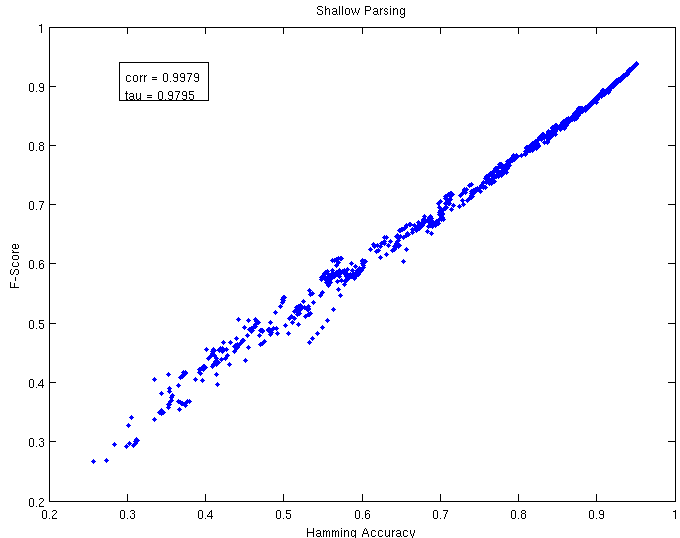
As we can see, the relationship is ridiculously strongly linear. Basically once we've gotten above an accuracy of 80%, it would be really really hard to improve accuracy and not improve F-score. The correlation coefficient for this data is 0.9979 and Kendall's tau is 0.9795, both indicating incredibly strong correlation (formal caveat: these samples are not independent).
For the NER task, I do the same experiments, but this time I keep track of accuracy, F-score and (a slightly simplified version of) the ACE metric. The results are below (again, click for a bigger version):

The left-most image is accuracy-versus-F, the middle is accuracy-versus-ACE and the right is F-versus-ACE. The ACE seems to be the outlier: it produces the least correlation. As before, with accuracy-to-F, we get a ridiculously high correlation coefficient (0.9959) and tau (0.9761). This drops somewhat when going to accuracy-to-ACE (corr=0.9596 and tau=0.9286) or to F-to-ACE (corr=0.9715 and tau=0.9253).
Nevertheless, the majority of the non-linearity occurs in the "very low accuracy" region. Here, that region is in the 0.8-0.9 range, not the 0.1-0.5 range as in chunking. This is because in chunking, almost every word is in a chunk, whereas in NER there are a ton of "out of chunk" words.
The take-away from these experiments is that it seems like, so long as you have a reasonably good model (i.e., once you're getting accuracies that are sufficiently high), it doesn't really matter what you optimize. If your model is terrible or if you don't have much data, then it does. It also seems to make a much bigger difference if the end metric is F or ACE. For F, it's pretty much always okay to just optimize accuracy. For ACE, it's not so much, particularly if you don't have sufficient data.
25 February 2007
Language and X
I feel it is increasingly interesting to look at problems that have both a linguistic and a non-linguistic signal. The simplest example I can think of here is recent work in looking at images and their captions (eg., the matching words and pictures approach, though this is not the only such example). The idea in many of these techniques is that we have a single data set that contains two types of data. One is language (eg., the captions) and the other is something else (eg., the images). There are many other potentially interesting sources of data like this that I'll discuss after saying why I think these problems are interesting.
I think there are two basic reasons why such "dual" problems are interesting:
- By looking at multiple modalities, we can get cross-modality reinforcement of what we're learning. I think a great example of that is this paper, which uses face recognition together with textual coreference in order to do unsupervised coref in captions. The idea is that if you can tell that two different pictures contain the entity we call "Bill Clinton" in them, then it's more likely that a name in their caption will corefer. This gives us a greater ability to share data across a single data set.
- When language is treated in the context of some other source of information, we get a sort of grounding effect. That is, continuing the coref example from #1, we have--in some sense--grounded the string "Bill Clinton" to a pictorial representation of a person. Sure, this representation is still just a bunch of symbols, but they're markedly different symbols from the ones we use to represent the entity in purely linguistic terms. Perhaps hard-core cognitive scientists wouldn't call this grounding, but it's getting there. (Also along these lines, one of my favorite papers from a few years ago was my ex-ISI friend Mike doing grounding by looking and language and action in video games.)
It seems that vision+language is the hot topic, or at least the warmest of the bunch. This is probably because vision people and language people tend to overlap and meet at machine learning conferences. It's probably also because the sorts of techniques used by the two communities are perhaps the most similar. But I think there's lots of room for looking at other "X"s. For instance, biology. There are lots of data sets (eg., GEO) that contain textual information ("these are cell lines depicting ovarian cancer") plus the actual cell lines. Heck, many papers in PubMed contain such information, albeit in figures rather than matrices. Robotics is another option. Ray Mooney's group down in Texas has worked at understanding orders given to robocup competitors based on language information (eg., this paper). Perhaps the oldest that actually lives within the NLP community is NLP + databases, which we really haven't seen much of in the past 5-10 years.
I think this is an interesting and fruitful area of future research and is one that I'll probably be exploring myself (but I won't give away what "X"s!).
13 February 2007
I Don't Think We Understand Structured Prediction
I've posted on structured prediction a few times before and then some. This is another post, but with a different perspective. Besides, the most recent time was last May, so it's been a while. This post is prompted by a recent OpEd by John Lafferty and Larry Wasserman on Challenges in Machine Learning in Statistica Sinica, where they mention SP as one of three major open questions in machine learning (the other two are semi-sup and sparse learning in high dimensions).
I've been trying to think of a good way of ontologizing SP methods recently, primarily because I want to understand them better. The more I think about it, the more I feel like we really don't understand the important issues. This is partially evidenced by an observation that in the past six years (essentially, since the first CRF paper), there have been like 30 different algorithms proposed for this problem. The fact that there are so many proposed algorithms tells me that we don't really understand what's going on, otherwise we wouldn't need to keep coming up with new techniques. (I'm not innocent.)
To me, the strongest division between techniques is between techniques that require tractable inference in the underlying problem (eg, CRFs, M3Ns, SVM-struct, structured perceptron, MIRA, MEMMs, HMMs, etc.) and those that don't (eg, incremental perceptron, LaSO, Searn, the Liang/Lacoste-Julien/Klein/Taskar MT algorithm, local predictors ala Roth and colleagues, etc.). Whether this truly is the most important distinction is unclear, but to me it is. I think of the former set as a sort of "top down" or "technology-push" techniques, while the latter are a sort of "bottom up" or "application-pull" techniques. Both are entirely reasonable and good ways of going at looking at the problem, but as of now the connections between the two types are only weakly understood.
An alternative division is between generative techniques (HMMs), conditional methods (CRFs) and margin-based techniques (everything else, minus Searn which is sort of non-committal with respect to this issue). I don't really think this is an important distinction, because with the exception of generative being quite different, conditional methods and margin-based methods are essentially the same in my mind. (Yes, I understand there are important differences, but it seems that in the grand scheme of things, this is not such a relevant distinctions.)
A related issue is whether the algorithms admit a kernelized version. Pretty much all do, and even if not, I also don't see this as a very important issue.
There are other issues, some of which are mentioned in the Lafferty/Wasserman paper. One is consistency. (For those unfamiliar with the term, a consistent algorithm is essentially one that is guaranteed to find the optimal solution if given infinite amounts of data.) CRFs are consistent. M3Ns are not. Searn is not, even if you use a consistent classifier as the base learning algorithm. My sense is that to statisticians, things like consistency matter a lot. In practice, my opinion is that they're less important because we never have that much data.
Even within the context of techniques that don't require tractability, there is a great deal of variation. To my knowledge, this family of techniques was essentially spawned by Collins and Roark with the incremental perceptron. My LaSO thing was basically just a minor tweak on the IP. Searn is rather different, but other published methods are largely other minor variants on the IP and/or LaSO, depending on where you measure from. And I truly mean minor tweaks: the essentially difference between LaSO and IP is whether you restart your search at the truth when you err. Doing restarts tends to help, and it lets you prove a theorem. We later had a NIPS workshop paper that restarted, but allowed the algorithm to take a few steps off the right path before doing so. This helped experimentally and also admitted another theorem. I've seen other work that does essentially the same thing, but tweaks how updates are done exactly and/or how restarts happen. The fact that we're essentially trying all permutations tells me that many things are reasonable, and we're currently in the "gather data" part of trying to figure out the best way to do things.
10 February 2007
AI-Stats schedule/papers up
The papers weren't listed in a single location, so I assembled them in one page. Looks like it should be fun (and sunny)!
05 February 2007
Bag of Words citation
I was recently asked by a colleague if I knew what the first paper was that used the bag of words model. I'm pretty certain it would be an IR paper, but have no idea what I would be. Manning+Schutze and Jurafsky+Martin don't have it. I know tf-idf is due to Sparck-Jones, but I presumably BOW existed before that. The vector space model is often credited to Salton, which is probably the earliest thing I know of, but my guess is that BOW predated even that. Anyone know a citation?
03 February 2007
To err is human, but what about researchers?
Errors happen and sometimes get in to papers. A recent example is the JAIR paper I had with Daniel on Domain Adaptation last year. I actually didn't catch the error myself -- it was caught by someone who was reimplementing the technique. And it's a totally not-insignificant error: essentially, the update equation for the generative parameters is completely botched. If you look through the derivation in the Appendix, it's clear where the error crept in.
Thankfully, this sort of error is essentially a typo. That is, the error was introduced when I was typing up the paper, not when I was doing the research. Why this is important is that it means the the implementation reflects the correct updates: only the paper has the mistake. This means that the experimental results from the paper are valid, contingent on the fact that you rederive the updates yourself, or just ask me what they should be.
I'm writing this post because it's somewhat unclear what to do when such a thing arises. One temptation is to do nothing. I have to admit that I was completely embarrassed when this was pointed out to me. There was a part of me that wanted to ignore it. It seems that this is the wrong approach for a variety of reasons, not the least of which is to make sure that correct information does get out. The question, to some degree, is exactly how to do this. I have a blog, which means I can write an entry like this. I can also put an errata on my web page that points out the errors (I'm writing this up as we "speak"). Given that this is a pub in an online journal, I believe I am able to submit updates, or at least additional appendices, which means that the "official version" can probably be remedied.
But what about conference pubs? If this had appeared in ACL and I didn't have a blog, the situation would be something different (ironically, an earlier version with the correct updates had been rejected from ACL because the derivations were omitted for space and two reviewers couldn't verify them). Also, what if someone hadn't pointed it out to me? I certainly wouldn't have noticed -- that paper was behind me. But then anyone who noticed the errors might dismiss the results on the grounds that they could assume that the implementation was also incorrect (it's not inconceivable that an erroneous implementation can still get good results). This would also not be good because the idea in the paper (any paper with such errors) might actually be interesting.
False things are published all the time. The STOC/FOCS community (i.e., theory community) has a handful of examples...for them, errors are easy to identify because you can prove the opposite of any theorem. I recall hearing of a sequence of several papers that incrementally used results from a previous, but the first was in error, putting the rest in error (I also recall hearing that many of the subsequent results could be salvaged, despite the ancestral mistake).
I don't know if there's a good solution, given our publication mechanisms (essentially, publish-once-then-appear-in-the-anthology). But I'm pretty sure mine is not the first paper with such errors. At least I hope not :).
28 January 2007
Good News on ACL Reviews
I'm reviewing for ACL again this year (in the machine learning subcomponent). A couple of days ago, I received my notice to start bidding on papers (more on bidding below). The email came with the following note:
Naturally, reviewers have been chosen to assess papers based on their own expertise and outlook. Having said this, we are aware that ACL has sometimes been perceived, especially in recent years, as overemphasizing the pursuit of small incremental improvements of existing methods, perhaps at the expense of exciting new developments. (ACL is solid but boring, is what some people would say.) While we believe that it would be counterproductive to change course radically -- We certainly would not want to sacrifice solidity! -- we would like to encourage you, as a reviewer, to look out particularly for what's novel and interesting, even if this means accepting a paper that has one or two flaws, for example because it has not been evaluated as rigourously as you would like. (It is for you to judge when a flaw becomes a genuine problem.)I think this is fantastic! (Would someone who is reviewing---i.e., on the PC---for another area confirm or deny that all areas got such a message, or was it just ML?) One difficulty I always have as a reviewer is that I assign scores to different categories (originality, interest, citations, etc.) and then am asked to come up with a meta-score that summarizes all these scores. But I'm not given any instruction on how to weigh the different components. What this note seems to be doing is saying "weigh interest higher than you usually would." In the past two years or so, I've been trying to do this. I think that when you start out reviewing, it's tempting to pick apart little details on a paper, rather than focusing on the big picture. It's been a conscious (and sometimes difficult) process for me to get over this. This explicit note is nice to see because it is essentially saying that my own internal process is a good one (or, at least, whomever wrote it thinks it's a good one).
I also think---in comparison to other conferences I've PCed for or reviewed for---that ACL does a really good job of moderating the bidding process. (For those unfamiliar with bidding... when a paper gets submitted, some area chair picks it up. All papers under an area chair are shown---title plus abstract---to the reviewers in that area. Reviewers can bid "I want to review this," "I don't want to review this," "I am qualified to review this," or "Conflict of interest." There is then some optimization strategy to satisfy reviewers preferences/constraints.) In comparison to ECML and NIPS in the past, the ACL strategy of dividing into area chairs seems to be a good thing. For ECML, I got a list of about 500 papers to select from, and I had to rank them 1-5 (or 1-10, I don't remember). This was a huge hassle.
It seems that of most of the conferences that I'm familiar with, ACL has a pretty decent policy. While I would be thrilled to see them introduce an "author feedback" step, everything else seems to work pretty well. In the past, I've only once gotten in to a real argument over a paper with other reviewers --- most of the time, all the reviewer scores have tended to be +/- 1 or 2 (out of ten) of each other. And for the times when there is an initial disagreement, it is usually resolved quickly (eg., one reviewer points out some major accomplishment, or major flaw, in the paper that another reviewer missed).
25 January 2007
Error Analysis
I was recently asked if I thought that it would be a good idea if our conferences were to explicitly require an error analysis to be performed and reported in papers. While this is perhaps a bit extreme (more on this later), there are at least two reasons why this would be desirable.
- When multiple techniques exist for solving the same problem, and they get reasonably close scores, is this because they are making the same sort of errors or different sorts?
- If someone were to build on your paper and try to improve it, where should they look?
This situation reminds me a bit of an excellent talk I saw a few years ago (at ACL or EMNLP in Barcelona, I think) by Mitch Marcus talking about some parsing stuff. I don't really remember much of his talk, except that he kept flashing a single slide that read "Look at the data, stupid." His argument was essentially that we're not going to be able to model what we want to model unless we really understand what's going on in the data representing the phenomena we're trying to study.
An exercise that's also good from this perspective is to do some data annotation yourself. This is perhaps even more painful than doing an error analysis, but it really drives home the difficulties in the task.
Getting back to the point at hand, I don't think it's feasible or even necessarily advisable to require all papers to include an error analysis. But I also think that more papers should contain error analyses than actually do (including some of my own). In the universal struggle to fit papers within an 8 page limit, things have to get cut. It seems that the error analysis is the first thing to get cut (in that it gets cut before the paper is even written -- typically by not being performed).
But, at least for me, when I read a paper, I want to know after the fact what I have learned. Occasionally it's a new learning technique. Or occasionally it's some new useful features. Or sometimes it's a new problem. But if you were to take the most popular problems out there that I don't work on (MT, parsing, language modeling, ASR, etc.), I really have no idea what problems are still out there. I can guess (I think names in MT are hard, as is ordering; I think probably attachment and conjunctions in parsing; I have little idea in LM and ASR), but I'm sure that people who work on these problems (and I really mean work: like, you care about getting better systems, not just getting papers) know. So it would be great to see it in papers.
18 January 2007
Comments on: Mark-up Barking Up the Wrong Tree
The "Last Words" article in the Dec 2006 issue of Computational Linguistics is by Annie Zaenen from PARC. (I hope that everyone can access this freely, but I sadly suspect it is not so... I'm half tempted to reproduce it, since I think it's really worth reading, but I don't want to piss off the Gods at MIT press too much.)
The main point I got from the article is that we really need to pay attention to how annotation is done. A lot of our exuberance for annotating is due to the success of machine learning approaches on the Treebank, so we have since gone out and annotated probably hundreds of corpora for dozens of other tasks. The article focuses on coreference, but I think most of the claims apply broadly. The first point made is that the Treebank annotation was controlled, and done by experts (linguists). Many other annotates are not done so: are done without real standards and without deep analysis of the task. The immediate problem, then, is that a learning algorithm that "succeeds" on the annotated data is not necessarily solving the right task.
There was a similar story that my ex-office-mate Alex Fraser ran across in machine translation; specifically, with evaluating alignments for machine translation. The basic problem was two-fold. First, the dataset that everyone used (the French-English data from Aachen) was essentially broken, due largely to its distinction between "sure" and "possible" links -- almost every word pair was possibly linked. This, together with the broken evaluation metric (alignment error rate --- or AER) made results on this dataset virtually useless. The conclusion is essentially: don't use the Aachen data and don't use AER. That is, don't use them if you want improved MT performance, i.e., if you expect higher alignment performance to imply higher MT performance. (If this sounds familiar, it's perhaps because I mentioned it before.)
I should say I largely agree with the article. Where I differ (perhaps only by epsilon) is that the article seems to pick on annotation for machine learning, but I really don't see any reason why the fact that we're using machine learning matters. The issue is really one of evaluation: we need to know that at the end of the day, when we compute a number, that number matters. We can compute a number intrinsically or extrinsically. In the extrinsic case, we are golden, assuming the extrinsic task is real (turtles upon turtles). In the intrinsic case, the situation is fishy. We have to make sure that both our annotations mean something and our method of computing error rate means something (ala the error metric types and the use of F for named entities). While I've argued on this blog that the error metric is important, the CL article argues that the annotation is important. I think that as someone who is on the machine learning side, this is easy to forget.
12 January 2007
Survey of Parser Usage
I know people use parsers a fair amount; I'm curious which parsers people use. Thus, a new poll :). What I'm interested in, in particular, is if you use a parser essentially as a preprocessing step before doing something "higher level." In other words, if you are Mark Johnson and you use the Charniak parser to build a better parser, this doesn't count (sorry, Mark!). I want to know if you use one to do, eg., summarization or MT or IE or something other than parser... (Also, I don't count shallow parsing in this context.) I look forward to responses!
07 January 2007
What Irks Me about E-mail Customer Service
I hate dealing with customer service for large corporations, and it has little to do with outsourcing. I hate it because in the past few months, I have sent out maybe three or four emails to customer service peeps, at places like BofA, Chase, Comcast, Ebay, etc. Having worked in a form of customer service previously (I worked at the computer services help desk as an undergrad at CMU to earn some extra money), I completely understand what's going on. But "understand" does not imply "accept." I post this here not as a rant, but because I think there are some interesting NLP problems under the hood.
So what's the problem? What has happened in all these cases is that I have some problem that I want to solve, can't find information about it in the FAQ or help pages on the web site, and so I email customer service with a question. As an example, I wanted to contest an Ebay charge but was two days past the 60 day cutoff (this was over Thanksgiving). So I asked customer service if, given the holiday, they could waive the cutoff. As a reply I get a form email, clearly copied directly out of the FAQ page, saying that there is a 60 day cutoff for filing contests to charges. Well no shit.
So here's my experience from working at the help desk. When we got emails, we had the option of either replying by crafting an email, or replying by selecting a prewritten document from a database. This database was pretty huge -- many thousands of problems, neatly categorized and searchable. For emails for which the answer existed in the database, it took maybe 10 seconds to send the reply out.
What seems to be happening nowadays is that this is being taken to the extreme. A prewritten form letter is always used, regardless of whether it is appropriate or not. If it is a person doing this bad routing, that's a waste of 10 seconds of person time (probably more for these large companies). If it's a machine, it's no big deal from there perspective, but it makes me immediately hate the company with my whole heart.
But this seems to be a really interesting text categorization/routing problem. Basically, you have lots of normal classes (the prewritten letters) plus a "needs human attention" class. There's a natural precision/recall/$$$ trade-off, which is somewhat different and more complex than is standardly considered. But it's clearly an NLP/text categorization problem, and clearly one that should be worked on. I know from my friends at AT&T that they have something similar for routing calls, but my understanding is that this is quite different. Their routing happens based on short bits of information into a small number of categories. The customer service routing problem would presumably be based on lots of information in a large number of categories.
You could argue that this is no different from providing a "help search" option on the Ebay web page. But I think it's different, if for no other reason that how it appears to the user. If the user thinks he is writing an email to a person, he will write a good email with full sentences and lots of information. If he's just "searching" then he'll only write a few keywords.
NAACL Accepted Papers
See here.
I probably won't be going to NAACL, so if afterwards someone wants to volunteer to post a few papers they especially liked, I'd appreciate it!
02 January 2007
Learning when test and train inputs have different distributions -- NIPS workshop
I spent the second day of workshops at NIPS (while not skiing) attending the Learning when test and train inputs have different distributions workshop. This is closely related (or really just a different name) for the domain adaptation problem I've been interested in for quite some time. Unfortunately, I can't easily come across the list of papers (there were some good ones!) which means that my memory may be lacking at some parts. Here are some points I took away.
Statisticians have worked on this problem for a long time. If you provide insurance, you're going to want a predictor to say whether to give a new person a policy or not. You have lots of data on people and whether they made any claims. Unfortunately, the training data (people you have information on) is limited to those to whom you gave policies. So the test distribution (entire popular) differs from the training distribution (people to whom you gave policies). Some guy (can't remember his name right now) actually won a Nobel prize in Economics for a partial solution to this problem, which was termed "covariate shift" (because statisticians call our "inputs" "covariates" and they are changing).
There seems to be a strong desire to specify models which (though see the comment below) can be characterized as "train p(y|x) and test p(y|x) are the same, but train p(x) and test p(x) differ." In other words, the "labeling function" is the same, but the distribution over inputs is different. This is probably the clearest way to differentiate domain adaptation from multitask learning (for the latter, we typically assume p(x) stays the same but p(y|x) changes). I'm not sure that this is really a hugely important distinction. It may be to obtain interesting theoretical results, but my sense is that in the problems I encounter, both p(x) and p(y|x) are changing, but hopefully not by "too much." An interesting point made along these lines by Shai Ben David that I spent a bunch of time thinking about several years ago was that from a theoretical perspective, assuming p(y|x) is the same is a vacuous assumption, because you can always take two radically different p(x) and q(x), add a feature that indicates which (p vs. q) the data point came from, and call this the "global p(x)". In fact, in some sense, this is all you need to do to solve multitask learning, or domain adaptation: just add a feature saying which distribution the input is from, and learn a single model. I've been doing some experiments recently and, while you can do better than this in practice with standard learning models, it's not such a bad approach.
There were several other talks I liked. It seemed that the results (theoretically) were of the form "if p(y|x) is the same and p(x) and p(y) differ only by a 'little' then doing naive things for learning can do nicely." My favorite formalization of p(x) and p(y) differ a little was the Shai Ben David/John Blitzer approach of saying that they differ slightly if there is a single hyperplane that does well (has low error) on both problems. The restriction to hyperplanes is convenient for what they do later, but in general it seems that having a single hypothesis from some class that will do well on both problems is the general sense of what "p(y|x) is the same" is really supposed to mean. I also enjoyed a talk by Alex Smola on essentially learning the differences between the input distributions and using this to your advantage.
In general, my sense was that people are really starting to understand this problem theoretically, but I really didn't see any practical results that convinced me at all. Most practical results (modulo the Ben David/Blitzer, which essentially cites John's old work) were very NIPSish, in the sense that they were on unrealistic datasets (sorry, but it's true). I wholeheartedly acknowledge that its somewhat difficult to get your hands on good data for this problem, but there is data out there. And it's plentiful enough that it should no longer be necessary to make artificial or semi-artificial data for this problem. (After all, if there weren't real data out there, we wouldn't be working on this problem...or at least we shouldn't :P.)
20 December 2006
Back from NIPS
The holidays are upon us (hence the lack of posts), but I wanted to give a brief nod to NIPS, which I thought went pretty well this year. The highlights for me (note that I didn't attend everything, so the usual qualifications apply) were:
- The Netflex Prize talk: Bennett talked about the origins of the prize and how well people are doing. They seem to firmly believe that the goal will be met. There's some indication it actually won't take all that long. Currently leading the pack at the time of the talk was wxyz, who is one of my old CMU buddies, Yi Zhang, now at UCSC. Nearly tied for first was Geoff Hinton's group up at Toronto. There weren't any details given about what people are doing to do so well, but it seems reasonable to assume that Toronto is doing something with deep belief nets (more later).
- Free Lunches (Invited talk by Dan Ariely). This was probably my favorite talk of the whole conference. The gist of the talk is that it's really easy to get humans to behave in ways that defy the standard "cost/benefit analysis" setting. A few fun examples. Split a bunch of people into two groups. Have one group write down 3 things they like about their significant other; have the other group write 10 things. Then ask them how much they love their SO. The result is that the "3 things" group loves them much more (presumably because no one can actually list 10 things). There were also a lot of examples about how often people cheat; the basic result is that it seems that knowing you cannot be caught does not necessarily make you cheat more. Also, if you prime people by having them sign an honor code, they cheat less. There were many more examples. I'm not quite positive what the take-home message was, but it was a very interesting talk.
- Analysis of Representations for Domain Adaptation (Blitzer et al). This is the first compelling analysis I've seen of the domain adaptation problem. The basic idea is to bound generalization error based on the distance between the source and target distributions. Quite clever and John says that they may even try to develop algorithms that explicitly minimize this bound.
- Boosting Structured Prediction for Imitation Learning (Ratliff et al). A cute feature-boosting algorithm for SP problems, used for the "following a map" problem.
- Large Margin Gaussian MMs for ASR (Sha, Saul). Do standard Gaussian mixture modeling for ASR, but put a large margin constraint on the Gaussians. Do a hard-EM-like thing to get fixed cluster assignments, and you can write this as a semi-definite program. Very cute.
- Greedy Layer-wise Training of Deep Networks (Bengio et al). Deep belief nets can do a really good job at some vision problems, but they're quite hard to train (symmetries, etc.). The basic idea here is to initialize the training by a simple layer-at-a-time method. The thing I found especially interesting is that their initialization looks a lot like a "predict yourself" sort of strategy, which seems to be a recurring theme in a lot of unsupervised/semi-supervised learning problem.
20 November 2006
Feature engineering (with a coreference focus)
I gave a talk today at our small group meeting about feature engineering for coreference resolution problems. I think it is oft underappreciated by people (myself occasionally included) who spend a lot of time working on fancy machine learning algorithms that the difference between success and failure often hinges more on clever features than on fancy learning. For those who want to look at the slides, you can take an OpenOffice or PDF version for your perusal. I forewarn that it may be a bit hard to follow without the soundtrack, but it's sort of an "untold story" version of the coref paper we had at HLT/EMNLP 2005.
So what did we do that's clever (or, at least, as far clever as I knew at the time and know now)? Well, a few things. First, I tried extending the notion of Hobbs' distance to discourse trees. This actually works surprisingly well. The true referent is the first element according to syntactic Hobbs' distance in about 70-80% of the cases and we (almost) see the same thing at the discourse level. The only oddity is that you have to flip the nuclearity of the attribution relation. Then you get about 80% holding, assuming perfect discourse trees. Of course, we never have perfect discourse trees and the noise introduced by poor parsing is enough to make this feature more or less useless.
The second thing we tried was to use this name/instance data that Mike Fleischman gathered at ISI before going off to MIT. This data was gathered in the context of Q/A to answer questions like "Who is the president of the U.S.?" by using lookup-tables. But it's great data for coref! It includes about 2 million examples of names paired with their occupations. Maybe you can find this data interesting too. Mike describes it more in his ACL 2003 paper.
These guys make a huge difference in coref performance.
The next thing that helped a lot was a clever, non-standard use of gazetteers. What we do is take the ID of the gazetteer to which the anaphor belongs and pair it with the lexical item of the antecedent. Why? Well, suppose we have a gazetteer that contains words like "California" and "Utah" and "New York." By pairing this list id (eg., "list-5") with antecedents, we get features like "list-5 *AND* state" or "list-5 and country" etc. We'll probably learn that the former is a good feature and the latter is not. We also have a feature that checks to see if the two referents are on the same gazetteer but are not the same word. Why? This is a negative feature. "California" and "Utah" appear on the same list (states) but are not identical (string-wise). So they're probably not coreferent.
We tried pretty hard to get WordNet to work, but it just kept not helping. WordNet distance is a terrible measure (eg., "Japan" and "Russia" have distance 2 -- they are both under "country"). On the other hand, like in the gazetteer case, "nearby in WordNet but not the same word" is a reasonably good feature, though it turned out not to help much. Hypernym and hyponym were the most promising, but we never actually got any benefit from them.
The rest of the stuff in the talk made it fairly close to the front of the paper. The most surprising result was that count-based features help a lot! These features look at things like the entity to mention ratio, the number of entities detected so far, etc. These can't be included in a simple coref model that makes pairwise decisions, but for us it's easy.
The end result is that using just string-based features (standard "substring" and edit distance stuff), lexical features (word pairs), count-based features and Mike's data, we can get an ACE score of 87.6 using LaSO for doing the learning (this goes up about 0.8 if you use Searn in most cases, but I don't have all the numbers). Adding in some inference to predict things like number and gender gets you up to 88.3. Gazetteers get you up to 88.7. After that, the rest of the features (regular expression patterns, word clusters, WordNet, discourse, and syntax) don't help...all together, they get you up to 89.1, but that's not much bang for the buck.
My conclusion is basically that while learning makes a difference (Searn is a bit better than LaSO), the feature engineering makes a bigger one[*]. Many of the features we found useful were a priori not really that obvious. I spent a month or two of my life trying to come up with ways of being clever to help improve performance (playing on dev data so as to be fair). It's definitely a non-trivial enterprise, but it often pays off.
[*] This is assuming that your learning is robust enough to handle the features you want: for instance, the standard pairwise models could not handle the count-based features that helped us a lot.
17 November 2006
ICML 2007 webpage up
13 November 2006
Any Stem Cell Research?
I was listening to NPR a few weeks ago while pre-election news was still accosting my ears. Though not in my state (shockingly!), there was apparently a measure on the ballots in a lot of states referencing stem cell research. The title of the measure was, apparently, "Should any stem cell research be allowed?"
Okay, quick quiz: how did you first interpret that sentence? If you were in favor of certain varieties, but not all varieties of stem cell research, would you vote for it? In other words, does "any" mean "at least one type of" or "all types of"?
To me, and at least a few other people I've talked to, the prefered interpretation is "all"...it's also much easier to reach this interpretation if you put a bit of stress on "any." But it's also really easy to get the other interpretation by unstressing "any" or by putting another sentence in front of it (eg., "Stem cell research in all forms is purely evil." :P).
The strange thing is that I'm really having a hard time coming up with other examples where the preference for "all" is so strong (even with the stress). It seems that the fact that stem cell research is a class of things, rather than a single thing is important. It also seems that the presence of "should" is pretty much necessary. But even so, I really can't get anything else to come out with such a strong preference for "all".
So what does this have to do with NLP? Well, not too much other than language is hard. Something like this would probably kill a textual entailment system, but given that it's somewhat ambiguous even to people (the degree of ambiguity is person relative though: a Brit here tells me that he has a really hard time getting the "all" interpretation at all), maybe there's just nothing that can be done about it.
07 November 2006
Why Speech Summarization?
The vast majority of work on summarization is at the text level. A document (or collection of documents) comes in as text, and a summary goes out as text. Although I'm certainly not one of the ones pushing summarization of speech, I think it's quite an interesting task. (Here, by speech summarization, I pretty much mean speech in, speech out ... though similar arguments could be made for text in, speech out applications.) A lot of my conclusion comes from personal experience, but I also had a really great conversation with Alan Black (who works on speech synthesis problems).
Let me motivate this by an personal anecdote. My mom tends to leave really long voicemail messages. Like, really long. Usually she overruns the alloted time and has to call back. It's not uncommon for her messages to span three mailbox slots. (Sorry, mom, if you're reading this!) The most interesting thing about these messages is that they really don't contain that much information. In fact, there's usually only one or two sentences in the whole thing that really matter (at least from an "information" sense).
The problem is that you can't "skim" voicemail. If I get an equally long email (say, one that would take me 3 minutes to read), I can fairly easily skim it to get the gist. Especially with some tailored highlighting, I'm able to absorb much more text per second than speech per second. Word on the street (or at least around the croissant table at ACL) is that studies have been done that show that people can get at information from text just as fast if its presented in a summary as if its not summarized at all, essentially because we're really good at skimming (I knew high school English taught me something!). (Incidentally, if anyone has a reference for this, let me know. I believe I saw it ages ago, but I can't remember where and I'd love to have it.)
So one solution to the "Mom's message" problem is to run automatic speech recognition and turn it into an email. This has the added advantage that I check my email much more frequently than I check my voicemail, it gives me a record of the message after I've deleted the speech signal to save space, and allows for indexing. But there are also times when I don't have easy access to a computer and I really do want listen to the voicemail. This is where speech summarization becomes interesting.
Anyway, if you're now convinced that speech summarization is interesting, well, I don't really know what to tell you since I really haven't looked at this problem. The work I am aware of (and this is a very biased sample...I apologize that I missed something) is:
- Summarizing Speech Without Text Using Hidden Markov Models by Sameer Maskey and Julia Hirshberg
- Sentence-extractive automatic speech summarization and evaluation techniques by Makoto Hirohata, Yosuke Shinnaka, Koji Iwano and Sadaoki Furui (Furui has been working in this area for a while...I can't find this exact paper, but his lab has others)
- Evaluation of Sentence Selection for Speech Summarization by Xiaodan Zhu and Gerald Penn