Well, ACL and EMNLP are long gone. And sadly I missed one day of each due either to travel or illness, so most of my comments are limited to Mon/Tue/Fri. C'est la vie. At any rate, here are the papers I saw or read that I really liked.
P09-1010 [bib]: S.R.K. Branavan; Harr Chen; Luke Zettlemoyer; Regina Barzilay
Reinforcement Learning for Mapping Instructions to Actions
andP09-1011 [bib]: Percy Liang; Michael Jordan; Dan Klein
Learning Semantic Correspondences with Less Supervision
these papers both address what might roughly be called the grounding problem, or at least trying to learn something about semantics by looking at data. I really really like this direction of research, and both of these papers were really interesting. Since I really liked both, and since I think the directions are great, I'll take this opportunity to say what I felt was a bit lacking in each. In the Branavan paper, the particular choice of reward was both clever and a bit of a kludge. I can easily imagine that it wouldn't generalize to other domains: thank goodness those Microsoft UI designers happened to call the Start Button something like UI_STARTBUTTON. In the Liang paper, I worry that it relies too heavily on things like lexical match and other very domain specific properties. They also should have cited Fleischman and Roy, which Branavan et al did, but which many people in this area seem to miss out on -- in fact, I feel like the Liang paper is in many ways a cleaner and more sophisticated version of the Fleischman paper.P09-1054 [bib]: Yoshimasa Tsuruoka; Jun’ichi Tsujii; Sophia Ananiadou
Stochastic Gradient Descent Training for L1-regularized Log-linear Models with Cumulative Penalty
This paper is kind of an extension of the truncated gradient approach to learning l1-regularized models that John, Lihong and Tong had last year at NIPS. The paper did a great job at motivated why L1 penalties is hard. The first observation is that L1 regularizes optimized by gradient steps like to "step over zero." This is essentially the observation in truncated gradient and frankly kind of an obvious one (I always thought this is how everyone optimized these models, though of course John, Lihong and Tong actually proved something about it). The second observation, which goes into this current paper, is that you often end up with a lot of non-zeros simply because you haven't run enough gradient steps since the last increase. They have a clever way to accumulating these penalties lazily and applying them at the end. It seems to do very well, is easy to implement, etc. But they can't (or haven't) proved anything about it.P09-1057 [bib]: Sujith Ravi; Kevin Knight
Minimized Models for Unsupervised Part-of-Speech Tagging
I didn't actually see this paper (I think I was chairing a session at the time), but I know about it from talking to Sujith. Anyone who considers themselves a Bayesian in the sense of "let me put a prior on that and it will solve all your ills" should read this paper. Basically they show that sparse priors don't give you things that are sparse enough, and that by doing some ILP stuff to minimize dictionary size, you can get tiny POS tagger models that do very well.- D09-1006: [bib]
Omar F. Zaidan Chris Callison-Burch
Feasibility of Human-in-the-loop Minimum Error Rate Training
Chris told me about this stuff back in March when I visited JHU and I have to say I was totally intrigued. Adam already discussed this paper in an earlier post, so I won't go into more details, but it's definitely a fun paper. - D09-1011: [bib]
Markus Dreyer Jason Eisner
Graphical Models over Multiple Strings
This paper is just fun from a technological perspective. The idea is to have graphical models, but where nodes are distributions over strings represented as finite state automata. You do message passing, where your messages are now automata and you get to do all your favorite operations (or at least all of Jason's favorite operations) like intersection, composition, etc. to compute beliefs. Very cool results. - D09-1024: [bib]
Ulf Hermjakob
Improved Word Alignment with Statistics and Linguistic Heuristics
Like the Haghighi coreference paper below, here we see how to do word alignment without fancy math! - D09-1120: [bib]
Aria Haghighi Dan Klein
Simple Coreference Resolution with Rich Syntactic and Semantic Features
How to do coreference without math! I didn't know you could still get papers accepted if they didn't have equations in them!


 I hope you agree with my color coding. Now, let's apply consistency. In particular, let's move some of the red points, only reducing inter-clustering distances. Formally, we find the closest pair of points and move things toward those.
 The arrows denote the directions these points will be moved. To make the situation more visually appealing, let's move things into lines:
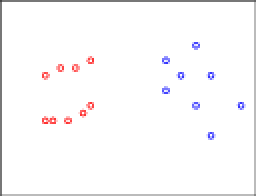 Okay, this is already looking funky. Let's make it even worse. Let's apply consistency again and start moving some blue points:
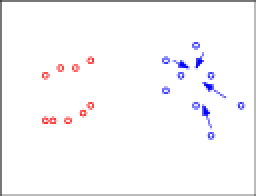 Again, let's organize these into a line:
 And if I had given you this data to start with, my guess is the clustering you'd have come up with is more like:
 This is a violation of consistency.